Monday, 17 March 2025

the music of west africa

The music of West Africa is multi-layered and multi-faceted.

This would be one element:

Jay Doubleyou: polyrhythm and different rhythms

For example:

Butour Ngale - African polyrhythm demonstration - YouTube [Senegal]

Chaabi. That Moroccan groove that made you go WHHAAATTTTTT - YouTube

Mongo Santamaria - Afro Blue - YouTube [Afro-Cuban]

Tony Allen & Hypnotic Brass feat Baaba Mal - Ise Nla - LIVE@Broad Casting, London 29/01/09 - YouTube [Nigeria and Senegal]

There is a rich instrumental heritage: 

The kora (Manding languages: ߞߐߙߊ kɔra[1]) is a stringed instrument used extensively in West Africa.[2] A kora typically has 21 strings, which are played by plucking with the fingers. It has features of the lute and harp.

Kora (instrument) - Wikipedia

With very famous players:

Toumani Diabaté obituary | Music | The Guardian

Toumani Diabaté & Sidiki Diabaté - Jarabi - YouTube

Ali Farka Touré & Toumani Diabaté - In The Heart Of The Moon - YouTube [intro in English]

This is part of an inherited tradition: 

A griot (/ˈɡriːoʊ/; French: [ɡʁi.o]; Manding: jali or jeli (in N'Ko: ߖߋ߬ߟߌ,[1] djeli or djéli in French spelling); also spelt Djali; Serer: kevel or kewel / okawul; Wolof: gewel) is a West African historian, storyteller, praise singer, poet, and/or musician.

Griot - Wikipedia

Griot Music of West Africa | Steve Pile AND Jali Bakary Konteh | TEDxSonomaCounty - YouTube [intro in English]

And there are very interesting collaborations...

Welsh harpist Catrin Finch and Senegalese kora player Seckou Keita met by chance in 2012, when Keita was called in to substitute for Toumani Diabaté in rehearsals for a tour with Finch. A military coup in Mali had prevented Diabaté from leaving the country in time, so Keita stepped in to help prepare the repertoire with Finch—a classical musician who had never seen or heard a kora before. For his part, Keita, a Senegalese kora master and griot of royal descent, didn’t read music. A wonderful musical partnership was born.

Catrin Finch & Seckou Keita: A Magical Partnership | KCRW 

Two Harps That Beat As One: Catrin Finch and Seckou Keita - YouTube

Bach to Baïsso - Catrin Finch and Seckou Keita - YouTube

Different traditions can fuse together...

Tishoumaren (ⵜⵉⵛⵓⵎⴰⵔⴻⵏ in Neo-Tifinagh script) or assouf,[1] internationally known as desert blues, is a style of music from the Sahara region of northern and west Africa. Critics describe the music as a fusion of blues and rock music with Tuareg, Malian or North African music.[2] Various other terms are used to describe it[1] including desert rock, Saharan rock,[3] Takamba,[2] Mali blues,[4] Tuareg rock[5] or simply "guitar music".[6] The style has been pioneered by Tuareg musicians in the Sahara region, particularly in Mali, Niger, Libya, Algeria, Burkina Faso and others; with it also being developed by Sahrawi artists in Western Sahara.[7]

The musical style took shape as an expression of the culture of the traditionally nomadic Tuareg people, amid their difficult sociopolitical situation, including rebellions, widespread displacement and exile in post-colonial Africa.[7] The word Tishoumaren is derived from the French word chômeur, meaning "the unemployed".[1]

The genre was first pioneered by and popularized outside of Africa by Ali Farka Touré and later Tinariwen. In recent years, artists like Mdou Moctar and Bombino have continued to adapt Saharan rock music and have achieved international success.[8][2][3][9][7]

Desert blues - Wikipedia

With a very special festival happening in Mali:

Festival au Désert - Wikipedia

Ali Farka Toure - Festival In The Desert 2003 - YouTube

The Tragic Story of Africa's Festival In The Desert - YouTube

Perhaps the most international music has come from Nigeria/Ghana:

Afrobeat (also known as Afrofunk[3][4]) is a West African music genre, fusing influences from Yoruba music[5][6] and Ghanaian music (such as highlife),[7] with American funk, jazz, and soul influences.[5][8] With a focus on chanted vocals, complex intersecting rhythms, and percussion,[9] the style was pioneered in the 1960s by Nigerian multi-instrumentalist and bandleader Fela Kuti, who popularised it both within and outside Nigeria. At the height of his popularity, he was referred to as one of Africa's most "challenging and charismatic music performers."[10]

Distinct from Afrobeat is Afrobeats, a combination of sounds originating in West Africa in the 21st century. This takes on diverse influences and is an eclectic combination of genres such as hip hop, house, jùjú, ndombolo, R&B, soca, and dancehall.[11][12][13][14][15][16] The two genres, though often conflated, are not the same.[12][13]

Afrobeat - Wikipedia

With its most famous proponent: 

Fela Aníkúlápó Kútì (born Olufela Olusegun Oludotun Ransome-Kuti; 15 October 1938 – 2 August 1997) was a Nigerian musician and political activist. He is regarded as the principal innovator of Afrobeat, a Nigerian music genre that combines West African music with American funk and jazz.[2] At the height of his popularity, he was referred to as one of Africa's most "challenging and charismatic music performers".[3] AllMusic described him as "a musical and sociopolitical voice" of international significance.[4]

Fela Kuti - Wikipedia

He was 'the president':

FELA KUTI Live at GLASTONBURY [Film Concert] - YouTube [intro in English]

Fela Kuti: Music Is The Weapon | Full Music Documentary Movie - YouTube

Faces of Africa - Fela Kuti: The Father of Afrobeat, Part 1 - YouTube

The Genius of Fela Kuti and Afrobeat (feat. Femi & Made Kuti) - YouTube

He had an important collaborator:

Tony Allen - Afrobeat Revolution (Full Album) 2020 - YouTube

To finish, from Ghana:

it is pure, rootsy, raw, driving African funk music of the highest order,

In 1976, Marijata made an african Raw Funk masterpiece

Marijata - No Condition Is Permanent - YouTube

.

.

.

Monday, 10 March 2025

different african english accents

Most Africans are bilingual:

In a cafe in south London, two construction workers are engaged in cheerful banter, tossing words back and forth. Their cutlery dances during more emphatic gesticulations and they occasionally break off into loud guffaws. They are discussing a woman, that much is clear, but the details are lost on me. It’s a shame, because their conversation sounds fun and interesting, especially to a nosy person like me. But I don’t speak their language.

Out of curiosity, I interrupt them to ask what language they are speaking. They both switch easily to English, explaining that they are South Africans and had been speaking Xhosa. In Johannesburg, where they are from, most people speak at least five languages, says one of them, Theo Morris. For example, Morris’s mother’s tongue is Sotho, his father’s is Zulu; he learned Xhosa and Ndebele from his friends and neighbours and English and Afrikaans at school. “I went to Germany before I came here, so I also speak German,” he adds.

Was it easy to learn so many languages? “Yes, it’s normal,” he laughs.

He’s right. Around the world, more than half of people – estimates vary from 60-75% – speak at least two languages. Many countries have more than one official national language – South Africa has 11. People are increasingly expected to speak, read and write at least one of a handful of “super” languages, such as English, Chinese, Hindi, Spanish or Arabic, as well. So to be monolingual, as many native English speakers are, is to be in the minority and perhaps to be missing out.

Why being bilingual works wonders for your brain | Language | The Guardian

Jay Doubleyou: ça va?! bilingualism is good for the brain

Much of Africa is Anglophone:

Jay Doubleyou: english is an african language

Jay Doubleyou: the english-speaking world: west africa

But each country and region has its own accent:

WHICH AFRICAN COUNTRY HAS THE BEST ENGLISH ACCENT - YouTube

KENYANS HAVE THE BEST ENGLISH ACCENT & PRONUNCIATION. DO SOUTHERN AFRICANS NEED TO RELEARN ENGLISH? - YouTube

Here is an excellent overview:

Accents of Africa | IDEA: International Dialects of English Archive

And here's a nice conversational view of being South African:

Language: Accents, dialects, and the Queen’s English - SPEAK Blog

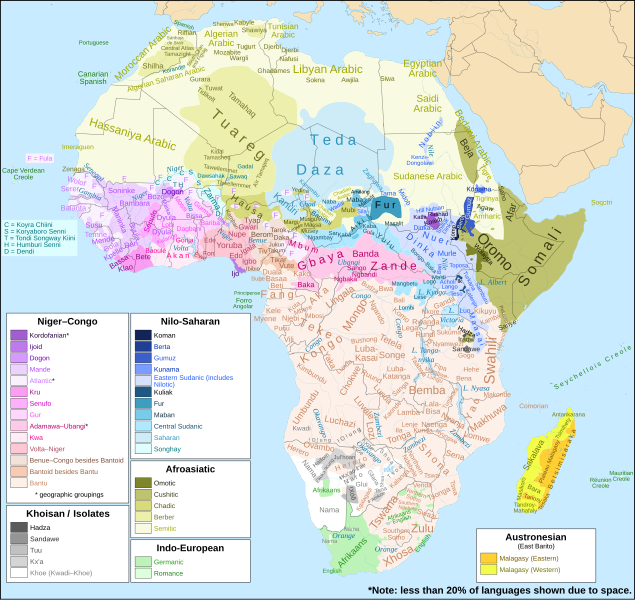
Finally, here 


Languages of Africa - Wikipedia


635px-Map_of_African_languages.svg.png (635×600)

.

.

.

Friday, 7 March 2025

it ain't what you say, it's the way that you say it: intonation and functional language

INTONATION AND FUNCTIONAL LANGUAGE

'It ain't what you say it's the way that you say it.'

In focussing on 'getting the words right', both teachers and students often overlook the question of how intonation creates meaning.

Following on from a functional lesson ('telephoning') being observed, I'd like to consider how intonation interplays with functional language.

1) ADDING COLOUR: Once the notion of chunking has been firmly established, work on specific areas of intonation in connected speech:

(See: last chapters of 'Pronunciation Task's by Martin Hewings, CUP, for the basics)

Identifying stressed words/syllables:

dictionary work with 'schwa' for individual words prior to chunks unstressed forms of to/and/were - which are often the 'grammar words'! versus prominent words - which are normally the 'content' words rhythm in Whatdidhesay?/Yesofcourse/Whatdoyouearn?

Linking words together:

consonant+vowel - keepoffthegrass/putonyourclothes

assimilation, or some consonants changing nature - turnback!/Agoodpartybecomes = turmbackf/Agoopparty

vowel+vowel often needs /w/, /j/ or /r/ - Whoareyou?jTeaorcoffee?/Isthedooropen? elision, or the dropping of sounds - Canyouseehim/Ican'tunderstandher becomes Canyouseeim?/Icanunderstander

Students will be familiar with I'm/don't, but not that Areyoualright,mate? becomes ri'ma?

Mimicking the 'music' of the language:

Tonic words, or where there is a change in tone, normally indicate the prominent word -It'sontopofthebookcase or It'sontopofthebookcase

Rising tone can indicate what the listener already knows, whereas falling tone is 'news' - WhenareyougoingtoNewYork? (up = not sure) I'mflyingatteno'clock (down = I know)

Rising tone can also indicate that the speaker hasn't finished: the sound-scripted phone-call above would have rising tone at Canitakeamessaget and 'within' the phone­number

2) Students EXPERIMENT with intonation:

Students listen to clear and complete exponents and try them out themselves. PARROTING exactly what they hear - including pitch, pace, pauses, as above

Higher level students INTERPRET more varied exponents where intention and meaning are not clear. Content often contradicts use of voice:

Yes;. of course/I see. (When the speaker in fact doesn't agree)

Changing stress:

Idunno/Areyougonnago? becomes ldon'tknow/Areyougoingtogo

Whatdidyougetuptolastweek?/Wouldyoumindnotdoingthat,please?

Changing tone:

I'dliketo from down to up can show definite acceptance of an invitation to reservation

Wasitexpensive? from up to down can show curiosity to scolding

Really? from up-down to down-up

Work out with the students whether tone should be questioning or flatter

Changing function:

Trying to say a 'command' as a 'request' and vice-versa, whilst keeping the phraseology:

Iwaswonderingifyoucouldgivememycoat,please./Ablackcoffee.

Trying out different 'moods' to the same phrase, saying it weak/strong, pleading/demanding, authoritatively/patronisingly/sarcastically:

Canwegotothebeach?/Whydon'tyouloveme?

3) Start with the premise that most functional speech is made up of 'CHUNKS', that is, pieces of language which should be recognised as a single whole:

Could I have a cup of coffee?/I'll have the steak./Have you got any change?

Students should be given practice in saying these out loud - but as chunks: Repeating or reading these complete phrases as if they were one word.

Gaps in the wrong place would indicate hesitation:

CanlspeaktoJohn?/Wouldyoumindopeningthewindow?

Integrating set phrases into a complete conversation with correct pausing.

Speed does not equal fluency: it encourages students to blur chunks or stop mid-chunk. It'saboutnextWednesday. (pause.) I'msorrybutlcan'tmakeit (pause.) Canwemakeanotherdate? (pause.)

4) SOUND-SCRIPTING: Students take a ready-made audio script or a self-created conversation - then re-write it line by line. This can be done on a word-processor by pressing 'enter' at the end of each chunk to start a new line:

A: Hi.

Joehere. CanlspeaktoTim?

B: Sorry, He'snotin.

Canltakeamessage ordoyouwanttocallback?

A:Er

Canyoutakeamessage? 

ThisisJohn

Canhecallmebackon

01395

513

456?

It really does take off when students must ask themselves about both the appropriate phraseology to be adopted and the appropriate tone - depending on the role being played.

In other words, we are teaching our students to PLAY ROLES - to act out their lines convincingly - and 'with feeling'.

14th September 2008.

...

Here's the same but as images to download and photocopy:

.


.

.

.

Thursday, 6 March 2025

today is world book day in the uk and ireland!

There are are in fact several 'world book days': 

World Book Day - Wikipedia

In this part of the world it's Thursday 6th March:

World Book Day - World Book Day | World Book Day is a registered charity. Our mission is to give every child and young person a book of their own.

A lot of it is about getting kids to show how much they can enjoy reading:

Prepare yourself to see some utterly awesome World Book Day costumes! You've been uploading your character creations from authors like Roald Dahl and Dav Pilkey. Your outfits range from bears to queens to intergalactic Jedi knights...

World Book Day 2025: Your incredible costumes - BBC Newsround

But not everyone can afford a costume to show off at school:

World Book Day: Why schools are asking pupils not to wear costumes of favourite characters | The Standard

Let’s end the performative hell of compulsory World Book Day costumes | The Independent

The point really is to show young people in particular the joys of reading for pleasure:

World Book Day provides a fantastic opportunity to focus on reading for pleasure, supporting children's autonomy in book choice, and embedding a habit of reading that brings a wide range of benefits.

World Book Day 2025 – Ideas and Activities | National Literacy Trust | National Literacy Trust

As one young person says, it's been really inspiring:

Amaya, our youngest writer, describes how her love of books has shaped her mission to protect nature and her ambition to be a marine biologist...

...
File:Common Seal - Horsey Beach, Norfolk (44451475895).jpg - Wikimedia Commons

My mummy and daddy have always read books to me since I was a baby, and I now love to read them myself. I have two favourite books, which are Disney’s Frozen and Dolphin Tale.

Wednesday, 5 March 2025

teaching 'unplugged' twenty-five years on

Over the years, these pages have looked at 'teaching unplugged', the last time some six years ago:

Jay Doubleyou: the 'dogme' approach or 'teaching unplugged':

In fact, the idea started some twenty-five years ago:

Scott Thornbury came up with this approach in 2000, following on from an article he wrote questioning the reliance on coursebooks and other classroom staples.

What is the Dogme ELT approach or Teaching Unplugged? - English Lessons Brighton

Teaching Unplugged is the term used for a teaching method and philosophy which has three primary aims: teaching through conversation, taking out external input such as course book and technology and letting the lesson content be driven by the students rather than being pre-planned by the teacher. Based on the ‘Dogme ELT’ approach to teaching, its origins lie in an article written in 2001 by Scott Thornbury and Luke Meddings called ‘The roaring in the chimney’. They later wrote ‘Teaching Unplugged’, a comprehensive guide to this type of teaching and winner of the British Council ELTons award for Innovation in 2010.The ‘Teaching Unplugged’ or ‘Dogme ELT’ movement has a very strong following amongst teachers. In fact, Dogme ELT discussion list, which was originally set up in March 2000 by Scott Thornbury to help bring this style of teaching to the fore, has now been disbanded, not due to lack of interest but because he felt the support had become so strong the method was ready to stand alone.

The main reason it’s become so popular is that the main focus is one hundred per cent on the students’ actual language needs. Take for example the elementary student who comes into class and says excitedly ‘See..friend..no see….fifteen years!’ Instead of saying ‘Oh, that’s nice! Now open your book at page twenty seven, we’re looking at the past simple’, the teacher constructs the sentence on the board: ‘I’ve just seen a friend I haven’t seen for fifteen years!’ The beauty is that, even if this use of the present perfect doesn’t come up in your course until pre-intermediate, you’re confident that the student knows exactly what this means as it is her own sentence and you’re absolutely sure you’ve just taught her something new as she definitely couldn’t say it before. The teacher then encourages other questions if students take an interest. ‘How.. you…know?’ ‘Where…you..meet?’ ‘What..he ..do..fifteen years?’ ‘ He change?’ The teacher now has a board full of great questions and a topic which can then be used as the basis for the class.

Teaching Unplugged | TeachingEnglish | British Council

Here's the original piece:

USING THE RAW MATERIALS THORNBURY MEDDINGS 2001 - Google Search

With a different aspect on the whole approach given in 2012:

A dogme based approach from the learners’ perspective.

.

.

.

Tuesday, 4 March 2025

students making their own 'comprehension questions' in the esl/esol/tefl classroom

If we want students to learn to read and listen better, we can look at the ideas of Stephen Krashen:

Jay Doubleyou: to acquire a language you need lots of comprehensible input

Jay Doubleyou: "focus more so on input & absorbing the language"

Jay Doubleyou: krashen and the comprehensible input theory

Much of it is about getting the students to learn to read and listen by and for themselves:

Jay Doubleyou: creating learner independence outside of the classroom

Especially as learners need to work without a teacher:

Jay Doubleyou: how teaching interferes with learning

A teacher can be useful if they are getting the students to learn by themselves:

Studies have shown that passive engagement in a class or activity does not lead to better learning. In some cases it may have the opposite effect. Ask any teacher with a few years of experience and they will tell you that students who take part more in class are more likely to become more effective learners.

Asking questions to better examine an idea is perhaps the most essential tool to not only involve learners but also activate intellectual processes. Memory, recall, comprehension and reflection all take place during a debate or active discussion. Having These activities in the classroom allows for higher order thinking to take place.

Using Socratic Questions in the ESL/TEFL Classroom – ESL Debates

But what about getting the students to make up the questions themselves?

Here we have some 'fun' type of questions the students could put together to ask their colleagues:

12 Fun ESL Reading Comprehension Activities for All Levels!

For something more 'serious', we can go to the type of questions found in the Cambridge First Certificate exam:

B2 First preparation | Cambridge English

FCE Practice Tests for Reading and Use of English (Cambridge English: First)

And once we have the type of 'difficult' question in mind, we can then try and make up similar questions with almost any material - from film reviews and clips to news reports and sports commentary.

.

.

.

Monday, 3 March 2025

non-linear lesson planning in the esl/esol/tefl classroom

How do we go about planning a lesson?

We can throw out questions and see how they progress:

Jay Doubleyou: socratic method pt 2

We can focus on 'getting something done':

Jay Doubleyou: task-based learning

We can find lots of ready-made lesson plans to guide us through 'what to do':

Jay Doubleyou: free english lessons with esolcourses.com

But we need something flexible enough to manage different levels/expectations/personalities:

Jay Doubleyou: mixed levels in the esl/esol/tefl classroom

Perhaps a non-linear approach would help:

When it comes to learning new skills... every type of student is different. Some people prefer linear learning, others non-linear learning. Some excel by listening to a teacher in the classroom and absorbing the information from A to Z, others thrive by a learning process that doesn’t necessarily follow a fixed, pre-programmed path but is dynamic, interactive, and intuitive. As we are propelled into the future of work, the need for agile and efficient learning strategies is rising. So when we look at linear vs non-linear learning, what is the most effective approach.

Linear vs Non-linear Learning and the Future of Work

Duncan Foord writing in the E T Professional looks at 'lesson planning right from the heart':

Lesson Planning From The Heart PDF | PDF

As a colleague points out:

Back in August as I was preparing to teach my first ever teacher training course, I stumbled upon an article called Lesson planning right from the heart by Duncan Foord (English Teaching Professional, 93, July 2014 – the article is available here if you’re a subscriber), and the idea suggested there struck a deep cord with me; we discussed the article with the trainees on the very first day of the course, and I think it sent a very important message and made a lot of difference to the outcome of the whole course.

In his article, Foord suggests planning the lesson in a way that reflects the approach outlined above, by stepping away from a ‘linear’ lesson plan (in which the task comes at the end and might easily get sacrificed for time reasons) and instead thinking of the plan as a heart (the task, which is the lesson aim) – supported by activities, all of which are valuable, and yet ‘droppable’:


...

2014 take-aways – and a few resolutions | Olya Sergeeva's ELT blog

Here are some more ideas:

Using Linear and Non-linear Teaching Strategies to Meet the Multiple Learning Needs of Students  - Faculty Focus | Higher Ed Teaching & Learning

Is non-linear approach to teaching more effective than traditional coursebook approach? | TEFL Tips - YouTube

Non‐linearity and the observed lesson

.

.

.