Showing posts with label grammar. Show all posts

Thursday, 30 October 2025

listening to the languages of papua new guinea and questioning the notion of a 'universal grammar'

It's clear that language is a human thing.

But how has language come about? What do languages have in common?

Here are some ideas:

the language of thought hypothesis

learning theory: the poverty of the stimulus

paulo freire and the tabula rasa

steven pinker - and language

The most dominant theory comes from Chomsky:

theories of language learning and teaching: behaviourism vs nativism

chomsky and language acquisition

what makes us human: noam chomsky and human languages

behaviourism >>> krashen... pinker... skinner... chomsky

As Wikipedia summarises:

Universal grammar (UG), in modern linguistics, is the theory of the innate biological component of the language faculty, usually credited to Noam Chomsky. The basic postulate of UG is that there are innate constraints on what the grammar of a possible human language could be. When linguistic stimuli are received in the course of language acquisition, children then adopt specific syntactic rules that conform to UG.[1] The advocates of this theory emphasize and partially rely on the poverty of the stimulus (POS) argument and the existence of some universal properties of natural human languages. However, the latter has not been firmly established.

Other linguists have opposed that notion, arguing that languages are so diverse that the postulated universality is rare.[2] The theory of universal grammar remains a subject of debate among linguists.[3]

And the theory is indeed being debated.

This month, the British Academy Neil and Saras Smith Medal has just been awarded to Professor Nicholas Evans for his long and distinguished career working on endangered languages, both documenting hitherto undescribed languages and exploring the consequences of such data for general linguistic theory.

This is the linguist they can’t shut up

Nicholas Evans was wading out to a boat moored in the shallow Gulf of Carpentaria, off the northern coast of Australia, when he felt what he thought was a baby shark nipping at his heels. The “nips” were actually bullets hitting the sea on either side of him. They had exited a rifle wielded by a hungover pilot called Fletcher...

And this is his book, courtesy of the New European/World:

...

Words of Wonder: Endangered Languages and What They Tell Us (The Language Library) : Evans, Nicholas: Amazon.co.uk: Books

This is quite revolutionary when it comes to understanding human language, because, through a lifetime of deep listening, Nicholas Evans has reshaped the global study of languages:

Evans’ work has made a significant impact beyond academia – interpreting for Native Title cases and cultural heritage documentation, developing writing systems for previously unwritten languages, and helping revitalise endangered languages.

Evans is currently teaching in Garrthalala, Northeastern Arnhem Land at a new ‘bush uni’ initiative aimed at bridging the path to university studies for Yolŋu Matha-speaking students. He will return to Canberra next month to continue exploring how languages shape – and are shaped – by the ways humans think, feel, and imagine.

It’s a reminder that every language reveals a unique act of human imagination, and a testament to a lifetime spent listening deeply to the many voices of our world.

Interestingly, Chomsky was the first to receive the British Academy prize - as reported by the Observer this weekend on Cracking the code of Papua New Guinea’s undocumented languages:

The first winner of that medal, in 2014, was Noam Chomsky. Chomsky famously emphasised the commonalities across languages, the universal template or grammar that a baby is born with, that allows it to pick up any natural language with minimal prompting.

Evans thinks the Chomskyans are looking through the wrong end of the telescope, and that what defines language is its staggering diversity – the vast span of “engineering solutions” that evolution has found to the problem of human communication.

A language must allow a person to express any idea to another person, but it also has to be learnable by babies. These two constraints drive language evolution, but what nobody yet knows is where the limits of the possible lie. How big is the language design space? Or, to put it another way, how complex or expressive of the minutiae of human experience can a language become, before it becomes unlearnable?

The reason nobody knows this is because it is thought that only about 10% of the estimated 7,000 living languages are well documented. Since 90% of those languages are also endangered, with many of the unwritten ones being at the greatest risk of extinction, Evans has long argued for the need to record them.

The linguists who take on that painstaking task are constantly reminded of the ocean of diversity on whose shore they stand. “Almost every new language that comes under the microscope reveals unanticipated new features,” Evans and fellow linguist Stephen Levinson, then director of the Max Planck Institute for Psycholinguistics in Nijmegen, the Netherlands, wrote in a landmark 2009 paper questioning the mainstream Chomskyan view.

There is another reason why Evans considers documentation so vital. Language infuses everything we do, so studying it is, he says, “mainlining into the human experience” – past and present.

This is the research by Nicholas Evans and Stephen C. Levinson from 2009: With diversity in mind: Freeing the language sciences from Universal Grammar | Behavioral and Brain Sciences | Cambridge Core

The Evans-Levinson work is quite fundamental to what makes us human:

Linguistic diversity then becomes the crucial datum for cognitive science: we are the only species with a communication system that is fundamentally variable at all levels. Recognizing the true extent of structural diversity in human language opens up exciting new research directions for cognitive scientists, offering thousands of different natural experiments given by different languages, with new opportunities for dialogue with biological paradigms concerned with change and diversity, and confronting us with the extraordinary plasticity of the highest human skills.

Others have followed this up, looking at the myth of language universals and the myth of universal grammar:

It has been widely argued that an innate Universal Grammar (UG) must be postulated to explain two key observations: first, that languages share putatively “universal” patterns, which appear arbitrary from a functional, communicative point of view; and second, that children acquire language so readily from an apparently impoverished linguistic input (the “poverty of the stimulus” argument). The second point has been the subject of considerable recent interest, with many theorists arguing that linguistic input is richer than has previously been suspected (e.g., Pullum & Scholz 2002; Reali & Christiansen 2005) or that modern learning methods are richer than is often presumed (e.g., Chater & Vita´nyi 2007; Harman & Kulkarni 2007). The first argument, based on language universals, has gone relatively unchallenged in the cognitive science literature– but no longer. Evans & Levinson (E&L) provide powerful evidence that language universals are myth rather than reality, and hence, that this line of defense of UG is swept aside. It remains to be explained, though, how languages came to display such stunning diversity, and this is where research on language evolution may offer some insight.

Finally, another [Vyvyan] Evans has written a more accessible book challenging The Language Myth - but it was really not liked by the academic establishment:

In 2016, Language, the flagship academic journal of the Linguistic Society of America published a series of "Alternative (Re)views"[12] by six leading linguists, all addressing The Language Myth. Evans was originally invited to contribute a response to those articles. However, his submission was rejected by the journal's review editor.[13] Evans wrote an open-letter to the linguistics community claiming that he was being censored.[14]

.

.

.

Friday, 28 February 2025

teaching sport in the esl/esol/tefl class

There are many different approaches teachers can take when 'doing sport' in the English classroom.

Here are some ideas and lesson plans.

...

Saturday, 4 January 2025

using songs in the esl/esol/tefl classroom

We all love songs - and so they usually make a great resource in the language classroom.

There are lots of things in songs for the English learner:

Jay Doubleyou: conditionals in songs

Jay Doubleyou: singing songs to learn english

Jay Doubleyou: listening to song lyrics will help your pronunciation

Jay Doubleyou: modal verbs in song

And for the English teacher:

Jay Doubleyou: every song has its lesson plan

Jay Doubleyou: every song has its lesson plan - part two

The British Council has got some ideas:

How to use songs in the English language classroom | British Council

Using music and songs | TeachingEnglish | British Council

There are some good videos out there with more ideas:

5 ways to use songs to teach English - YouTube

12 fun activities you can do with pop songs in the ESL classroom - YouTube

Going beyond the conventional 'gap fill' exercise, here are some more activities suggested by Eleanor Spicer-Lundholm of the International Teacher Training Institute, Hastings, UK:

> Song in Strips: cut up the song into strips which the students need to put back together.

> Creative writing to Song: put some of the key words from the song on the board and ask the students to make them into a poem/email/short story in pairs; then share and share the 'original song'.

> Word partnerships to Song: put some of the key phrases on the board, but cut in half and in two columns, which the students have to put together in pairs; then play the song, with the students shouting out 'bingo' when they hear their collocation.

> Word order to Song: put all the words of a sentence, but mixed up, from a song on the board, which the students have to order in teams; then compare each team's sentences before playing the part of the song.

> Whoops! Find the mistakes: put up a 'wrong' version of sentences from the song where the students have to identify the 'mistakes' before listening and correcting.

> Mime to Song: standing in a circle, first the students listen to a line and copy the teacher's mime; then the students suggest mimes to further lines which the class agree to copy.

Here's a lesson plan from Fiona Aish at the Itafel - looking at teaching connected speech through songs:

> Play the first 2/3 lines from the song 2/3 times and get the students to write what they hear; confirm the correct version.

> Elicit from the students the stressed words and then the connected words; the students should try this in pairs with the following lines.

> Play the song's lines again, getting the students to tap the beat/rhythm; the students should then speak out... and sing the song (if they want!)

Finally, here's a list from OnTesol:

  • put the verse in the right order;
  • put the verbs in brackets in the correct tense/or, form of the verb (for example, gerund or infinitive);
  • identify the past tenses in the song (or, any other tense or grammar topic, for example, conditionals, modal verbs, reported speech…);
  • reorder the verses;
  • reorder the letters;
  • correct the words/mistake;
  • question on the theme, the message or meaning of the song to encourage discussion;
  • write to the protagonist and (give advice, or tell him what you think);
  • write the story in the song.
  • put the underlined words under the right column according to … (pronunciation, vocabulary related to any specific category, or a grammatical pattern);
  • complete the blanks with the words in the box;
  • choose the right word;
  • answer the questions;
  • match the verses;
  • check the words that you hear

Using Songs with Adult ESL Students

Have fun!

.

.

.

Wednesday, 8 May 2024

writing about your holiday in different registers

REGISTER: THE BASICS:

It's important to be able to handle different registers:

the way a speaker uses language differently in different circumstances. Think about the words you choose, your tone of voice, even your body language. You probably behave very differently chatting with a friend than you would at a formal dinner party or during a job interview.

What Is Register in Linguistics?

a variety of language used for a particular purpose or particular communicative situation. For example, when speaking officially or in a public setting, an English speaker may be more likely to follow prescriptive norms for formal usage than in a casual setting, for example, by pronouncing words ending in -ing with a velar nasal instead of an alveolar nasal (e.g., walking rather than walkin'), choosing words that are considered more "formal" (such as father vs. dad or child vs. kid), and refraining from using words considered nonstandard, such as ain't and y'all.

Register (sociolinguistics) - Wikipedia

With a little more here:

Jay Doubleyou: register

Jay Doubleyou: register: populism, culture wars and woke

Jay Doubleyou: learning to use the appropriate register @ fawlty towers

REGISTER: TRYING TO WRITE IN DIFFERENT VARIETIES OF ENGLISH

Here are some ideas about making writing more nuanced:

Jay Doubleyou: writing with register: a lesson in using different levels of 'politeness'

Here are some more ideas around the theme of writing about your holiday:

1: Write a postcard to a friend

2: Write the same but to a great-aunt

3: Write a report to a local town council which is asking for input from tourists - in its consultation on its local tourism policy. Make use of the specific holiday experiences as outlined in your postcards, but put it in the language and format of an official report, giving your opinions and any recommendations.

4: Write an academic piece analysing the different aspects of holidaying in this part of the world. Again, make use of the examples referred to in the above pieces, but in an impersonal style with no personal opinions, with reference to statistical data and other academic studies.

5: Write in a highly subjective manner, following the stream of consciousness style of Virginia Wolfe's "To the Lighthouse", a story of a family on holiday, recounting in the same type of language the feelings and impressions when on holiday as it happens: To the Lighthouse - Wikipedia and To-the-Lighthouse-Etext-Edited.pdf

.

.

.

Tuesday, 7 May 2024

youglish

Quite a useful tool for learning languages:

Improve your English pronunciation using YouTube

 - and not just English!

"dass Kann Ich Nicht" | Pronunciation of "dass Kann Ich Nicht" in German 

Here's a review:

What is YouGlish and How Does YouGlish Work?

YouGlish is a great resource for learning to correctly pronounce words. As the name suggests, this is setup for English speakers and uses YouTube to deliver those guidance videos. But it goes beyond that to many language options.

Crucially, this uses native speakers of the language from which the word originates. This means you can hear how that word is pronounced by someone who can speak it naturally in the local tongue.

Since this uses YouTube as its source, videos are super simple to access and can be played across a host of digital devices. 

YouGlish is a very valuable tool not only for individuals, but also for teachers with ELL and ESL students. 

You can narrow down your search by the word, by class, by phrase class, or by context. The tool also provides tips on how to improve English pronunciation – written below the video. This includes the phonetic pronunciation as well as suggestions of other words that help with pronunciation. 

What is YouGlish and how does YouGlish work? | Tech & Learning

And here's a look at how to use it:

YouGlish for the Classroom - YouTube

.

.

.

Monday, 18 March 2024

the grammar discovery approach to learning langugages

How do we teach and learn the grammar of a language?

The EL Gazette looks at a method :

In this article, teacher Joanna Buckle delves into the grammar discovery approach. But what is it and does it work?

One nineties development in English language teaching was the ‘grammar discovery’ approach. It’s now been around long enough to have been incorporated into a number of textbooks. In this method, students are given a set of examples of a particular grammar point, such as the present simple tense, and asked to extrapolate the rules for its use from the context. But how much theoretical backing does this approach have?

...

The grammar discovery approach - E L Gazette

Here's a good explanation, plus an example:

The idea is that students will ‘discover’ the grammar through a series of steps (these might be tasks, language awareness activities, pictures, questions, etc) and will deduce both the form and the meaning from the context(s).

Grammar teaching: The discovery technique | Article | Onestopenglish

Here's an excellent piece giving real insights:

It can be difficult for language teachers to make learning grammar in a language classroom interesting and engaging for students. After all, these rules and rubrics need to be learnt, understood, memorised and then put into repeated practice. So how can teachers make learning key grammar concepts more interesting? This blog post examines the two main approaches to learning grammar (i.e deductive and inductive) and then focuses on the inductive approach (also known as guided discovery) in further detail.

Deductive vs. inductive grammar teaching

It is widely acknowledged that there are two main approaches to teaching grammar in any language. As outlined above, these are known as deductive and inductive approaches.

  • A deductive approach is when the grammar rule is presented by the teacher and the student produces language based on that rule.
  • An inductive approach is when the rule is inferred by the student through some form of guided discovery. (i.e the teacher provides the students with a way to discover the rules for themselves.)

Notably the former approach is clearly more teacher-centred. But it does allow language teachers to deliberately highlight the item for attention and can also allow more time for actually practising it in spoken or written form. Given that inductive approaches are more learner-centred, we’ll make that the focus for this blog post, although it is worth pointing out that these approaches are usually most beneficial for students who have a base knowledge of the language. It’s clearly easier to work things out for yourself if you already have some knowledge in a subject.

What is Guided discovery in grammar teaching?

According to the British Council: “Guided discovery, also known as an inductive approach, is a technique where a teacher provides examples of a language item and helps the learners to find the rules themselves.”

In detail, guided discovery is a way for language educators to encourage students to make their own explanations for grammar / language rules with the support and guidance of their teacher. It’s a powerful alternative to the traditional “chalk and talk” approach and aims to mimic the way most people naturally learn a language i.e by picking up the rules as their learning and experience grows.

...

How guided discovery could transform your grammar teaching

And here's a video showing how it can be done:

Work it out yourself - Helping students with grammar, with Chris Redston - YouTube

.

.

.

Wednesday, 31 January 2024

of time lines and duration: the language and philosophy of time

TENSE VS ASPECT:

The English language (but not only the English language) does not really have a 'tense system' for its verbs: rather, it's all about aspect, whether the continuous/progressive aspect or the perfect aspect:

Each verb tense represents a different subjective view of time, and all of the different uses of a particular verb tense can be connected back to this same view. For example, the present perfect can be used in a number of different situations, but all the usages have a unifying characteristic - each use indicates that the speaker is looking back at a past event from the perspective of the present.

Jay Doubleyou: grammar workshop

There are two tenses in English, the ‘present’ and ‘past’ tense; these are the only verbs forms that do not require an auxiliary. We add further meaning and viewpoints to these basic forms through the use of aspect. Aspect allows the speaker to interpret the events being described and express how they view them.

Tense vs aspect – Collins

With much more here:

Grammatical aspect - Wikipedia

And here we get into very complex territory:

Tense and Aspect (Stanford Encyclopedia of Philosophy)

...

TIMELINES AND TABLES:

To what extent, then, can we rely on what the grammar books show us?

The following are the norm - but are really not helpful as they do not reflect how the English language is used - or, indeed, how humans perceive the flow of time (see below):


All the English tenses, timeline


Verb Tense Timelines - Learn English Grammar

The problem with these schemes is that they don't represent the way the English language represents time.

English is not Latin - or a Latin language - with its very fixed table of tenses:

How English became English – and not Latin | OUPblog

There is no future tense in English:

Why doesn't English have an inflected future tense? When did such a tense last appear in the history of the English language, or if it never existed during the process from the PIE to English, where did it come to Latin from? - Cult of Linguists - Quora

But, then, philosophically, we can say that the future is not a reality - and is only something seen from the present. Again, a question of aspect:

Jorge Luis Borges Quote: “The future has no other reality than as present hope, and the past is no more than present memory.”

For example, the 'going to' form is not a 'future form' any more that 'want/hope/plan' to are. The 'going to' form is an exact mirror image of the present perfect - looking forwards from now, rather than looking backwards from now:

Joel Swagman (Reviews / TESOL): The English Verb by Michael Lewis

"What's wrong with grammar teaching ?" - Persée

...

THE PHILOSOPHY OF TIME:

A lot of this confusion has to do with how we perceive 'time' - and there are many different ways to do that:

Two contrasting viewpoints on time divide prominent philosophers. One view is that time is part of the fundamental structure of the universe – a dimension independent of events, in which events occur in sequence. Isaac Newton subscribed to this realist view, and hence it is sometimes referred to as Newtonian time.[46][47]

The opposing view is that time does not refer to any kind of "container" that events and objects "move through", nor to any entity that "flows", but that it is instead part of a fundamental intellectual structure (together with space and number) within which humans sequence and compare events. This second view, in the tradition of Gottfried Leibniz[17] and Immanuel Kant,[48][49] holds that time is neither an event nor a thing, and thus is not itself measurable nor can it be travelled.

Time - Wikipedia

Arrow of time - Wikipedia

Eternalism (philosophy of time) - Wikipedia

Philosophical presentism - Wikipedia

Philosophy of space and time - Wikipedia

And we can get really quite deep into all of this:

Time (Stanford Encyclopedia of Philosophy)

The Experience and Perception of Time (Stanford Encyclopedia of Philosophy)

...

DURATION

This is an understanding of time which 'goes against' the science of Newton (and Einstein) but which seems to accord with how humans (and other creatures?) see time: again, it's a question of aspect:

Duration (French: la durée) is a theory of time and consciousness posited by the French philosopher Henri Bergson. Bergson became aware that the moment one attempted to measure a moment, it would be gone: one measures an immobile, complete line, whereas time is mobile and incomplete. For the individual, time may speed up or slow down, whereas, for science, it would remain the same.

Duration (philosophy) - Wikipedia

Our temporal experience of the world is not divided into a series of neat segments, yet that's how we talk about time.

Why philosopher Henri Bergson rejected the word "time" - Big Think

Melvyn Bragg and guests discuss the French philosopher Henri Bergson (1859-1941) and his ideas about human experience of time passing and how that differs from a scientific measurement of time, set out in his thesis on 'Time and Free Will' in 1889. He became famous in France and abroad for decades, rivalled only by Einstein and, in the years after the Dreyfus Affair, was the first ever Jewish member of the Académie Française. It's thought his work influenced Proust and Woolf, and the Cubists. He died in 1941 from a cold which, reputedly, he caught while queuing to register as a Jew, refusing the Vichy government's offer of exemption.

In Our Time - Bergson and Time - BBC Sounds

We don’t really experience life as a succession of separate conscious states, progressing along an imaginary line. Instead, we feel time as a continuous flow, with no clearly demarcated beginnings and ends. We should not therefore confuse an abstract, arbitrary notion of practical convenience with the underlying truth that is continuously confirmed by our own experience.

Henri Bergson and the Perception of Time | Issue 48 | Philosophy Now

.

.

.

Sunday, 3 December 2023

eurish

English is of course spoken across Europe:

English language in Europe - Wikipedia

And in the meantime, a language is emerging that is spoken across the continent but not in 'English speaking countries': 

It is mostly used among EU staff, expatriates and migrants from EU countries, young international travellers (such as exchange students in the EU's Erasmus programme) and European diplomats with a lower proficiency in the language.

Euro English - Wikipedia

This started about a decade ago:

Eurish has developed a grammar of its own

Do you speak Eurish? EU has its own language that's far too difficult | World | News | Express.co.uk

And now after Brexit:

One feature is the European uncountable noun — singular in native-speaker English but plural in Eurish: “he received feedbacks”, “we have a lot of informations” and “we are producing online contents”.

There are other Eurish differences. I have heard both Germans and Italians say “we discussed about” rather than “we discussed”. “I will answer to your question” is common in many European discussions. Writing in the World Englishes journal, Mr Modiano adds others: “I am coming from Spain” rather than “I come from Spain” and “We were five people at the party” rather than “There were five people at the party”.

Continental Europeans are increasingly unworried about what Brits think of their developing English.

The evolution of Eurish - Marginal REVOLUTION

Europe speaks its own post-Brexit English

Here's a look at the differences:

Preliminary observations on the differences between Eurish, Globish and “natural” English

With the full piece here:

ECA Subject Brief

The New European's Francis Beckett writes in the latest issue:

But at least, surely, English remains the language in which the European institutions work?

Well, in a sense. The language in which the commission does its business, in which meetings are held and all official documents are written, looks every year less and less like the language you and I speak.

The British staffers used to protect it, to point out gently that this or that construction might sound fine in French or Spanish but it wouldn’t do in the language of Shakespeare. But they are no longer there, and of the two remaining Anglophone nations, Ireland has chosen to nominate Gaelic as its official language, and Malta has nominated Maltese.

So a new language is developing, which may eventually be related to English only in the way that Yiddish is related to German, or Niçois to Italian. It is developing just as a new language always develops, by using English words in French, Spanish or Italian constructions, and by importing words from European languages. I’d be tempted to call it Eurish.

In Eurish, you do not attend a meeting; you assist a meeting, because the French word assister means attend. You don’t plan a project, you have a planification. A deposit is a caution (because it is in French.) Spanish has contributed “a planning” for a schedule, “formation” for education, and “actually” for currently.

More are added each year.

Replacing English as the commission’s working language would be difficult. But the French are taking the commission to court over certain examinations for commission posts being in English only; and increasingly it’s Eurish anyway.

Brexit has wiped Britain off the map - The New European

.

.

.

Wednesday, 4 October 2023

what are agglutinative languages?!

AGGLUTINATIVE LANGUAGE:

An agglutinative language is a type of synthetic language with morphology that primarily uses agglutination.

Agglutinative language - Wikipedia

There's lots of language to unpack there!

MORPHEME:

A morpheme is the smallest meaningful constituent of a linguistic expression.[1] The field of linguistic study dedicated to morphemes is called morphology.

In English, morphemes are often but not necessarily words. Morphemes that stand alone are considered roots (such as the morpheme cat); other morphemes, called affixes, are found only in combination with other morphemes. For example, the -s in cats indicates the concept of plurality but is always bound to another concept to indicate a specific kind of plurality.[2]

This distinction is not universal and does not apply to, for example, Latin, in which many roots cannot stand alone. For instance, the Latin root reg- ('king') must always be suffixed with a case marker: rex (reg-s), reg-is, reg-i, etc. For a language like Latin, a root can be defined as the main lexical morpheme of a word.

These sample English words have the following morphological analyses:"Unbreakable" is composed of three morphemes: un- (a bound morpheme signifying "not"), break (the root, a free morpheme), and -able (a bound morpheme signifying "an ability to be done").[3][4][5]

The plural morpheme for regular nouns (-s) has three allomorph

Morpheme - Wikipedia

SYNTHETIC LANGUAGE:

A synthetic language is a language which is statistically characterized by a higher morpheme-to-word ratio. In contrast to analytic languages, which break up concepts into separate words, synthetic languages combine (synthesize) them into a single word.

hypercholesterolemia (υπερχοληστερολαιμία)

hyper-

high

cholesterol

cholesterol

-emia

blood

the presence of high levels of cholesterol in the blood.

  • alternately, cholesterol can be read as chole- + στερεός(stereós) + -ol, as in "bile + solid + [alcohol suffix]", or "the solid alcohol present in bile".
házaitokban

ház

house

-a

poss

-i

pl

-tok

your.pl

"In your houses"

Synthetic language - Wikipedia

Going beyond Wikipedia:

Agglutinative languages form words through the combination of smaller morphemes to express compound ideas. Each of these morphemes generally has one meaning or function and retains its original form and meaning during the combination process. For languages that have agglutinative morphology, such as Turkish, Finnish, Hungarian, or Korean, it is possible to produce thousands of forms for a given root word.

The following table shows a list of inflected forms for the Finnish word "talo" ("house").

WordTranslation
TaloHouse
TaloniMy house
TalossaIn the house
TalossaniIn my house
TalojaHouses
TaloissaIn the houses

 Inflected languages, such as English, French, and Latin, have a very small number of possible word forms for a given root word. In inflected languages, morphemes influence one another when binding. Most changes in inflection are present in the stem or word ending. In contrast to agglutinative languages, inflected languages tend to have different functions for a single morpheme. For example, a morpheme can determine both number and case.

Agglutinative Languages | Microsoft Learn

And:

Agglutinating language is a language which has a morphological system in which words as a rule are polymorphemic and where each morpheme corresponds to a single lexical meaning.

Examples

Classical examples of agglutinating languages are Turkish and Quechua.

(i) Turkish

ev-ler-i-den
housePL-POSS-ABL
'from their house'

(ii)Quechua

maqa-chi-naku-rka-n
beatCAUS-RECP-PL-3
'They let each other be beaten.'

Agglutinating language - Glottopedia

LANGUAGE TYPES: AN OVERVIEW:

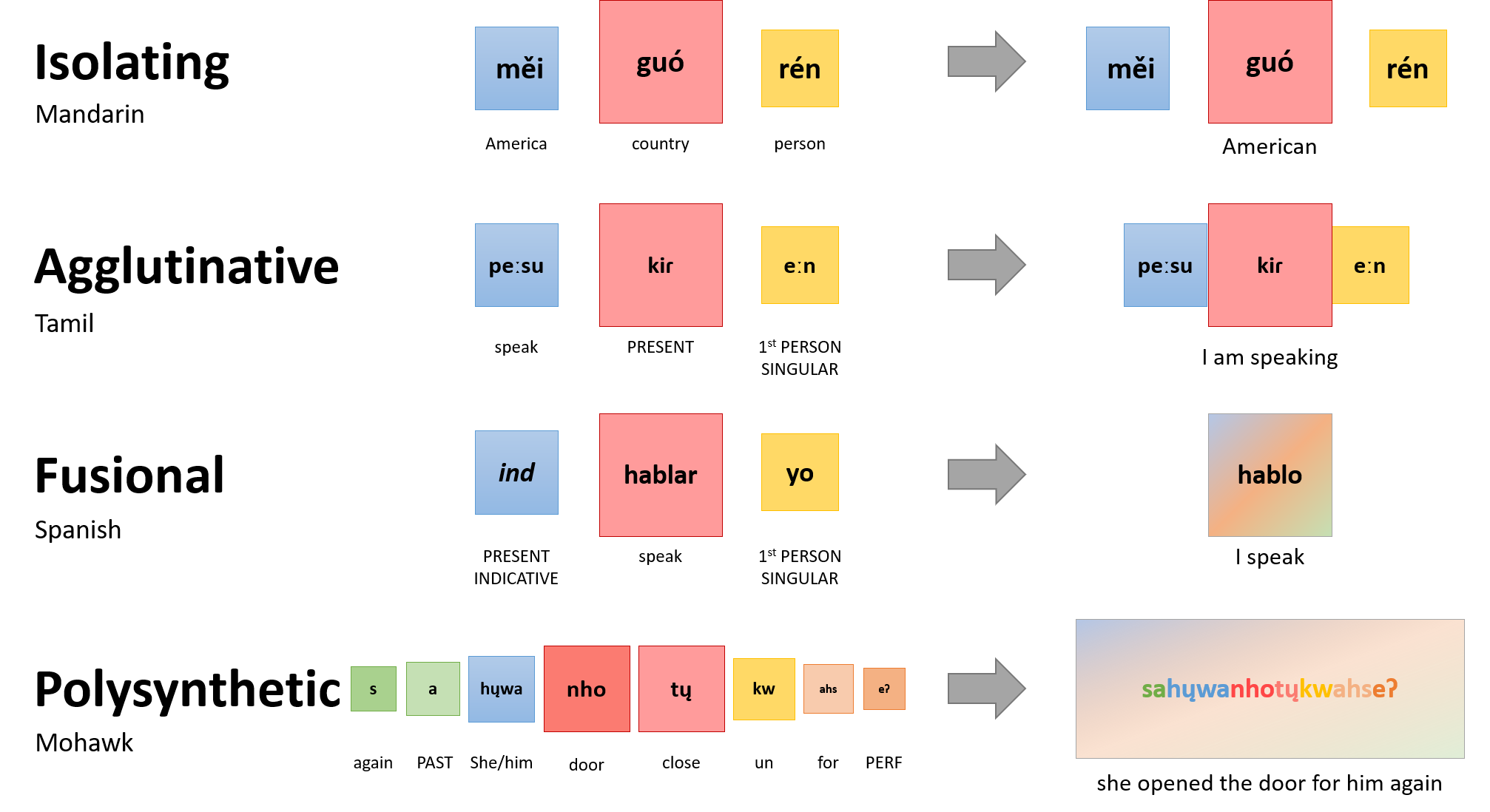
The way in which morphemes are employed to modify meaning can vary between languages.  is a method used by linguists to classify languages according to their morphological structure. While a variety of classification types have been identified, we will look at a common method of classification: analytic, agglutinative and fusional. Figure 3.2 give some examples of morphological typology across the world’s languages.

 have a low ratio of morphemes to words. They are often  in that each morpheme is also a word and vice versa. These languages create sentences with independent root morphemes with grammatical relations between words being expressed with separate words. Examples of analytics or isolating languages include Chinese languages and Vietnamese. While in English we inflect numbers: one day, two days, an analytic language such as Mandarin Chinese has no inflection: 一天, yì tiān “one day”, 三天, sān tiān “three day”. The Canadian linguist and translator Sonja Lang has created an analytic language, Toki Pona, as a minimalist creative endeavour.

image description linked to in caption
Figure 3.2 Examples of Morphological Typology [Image description]

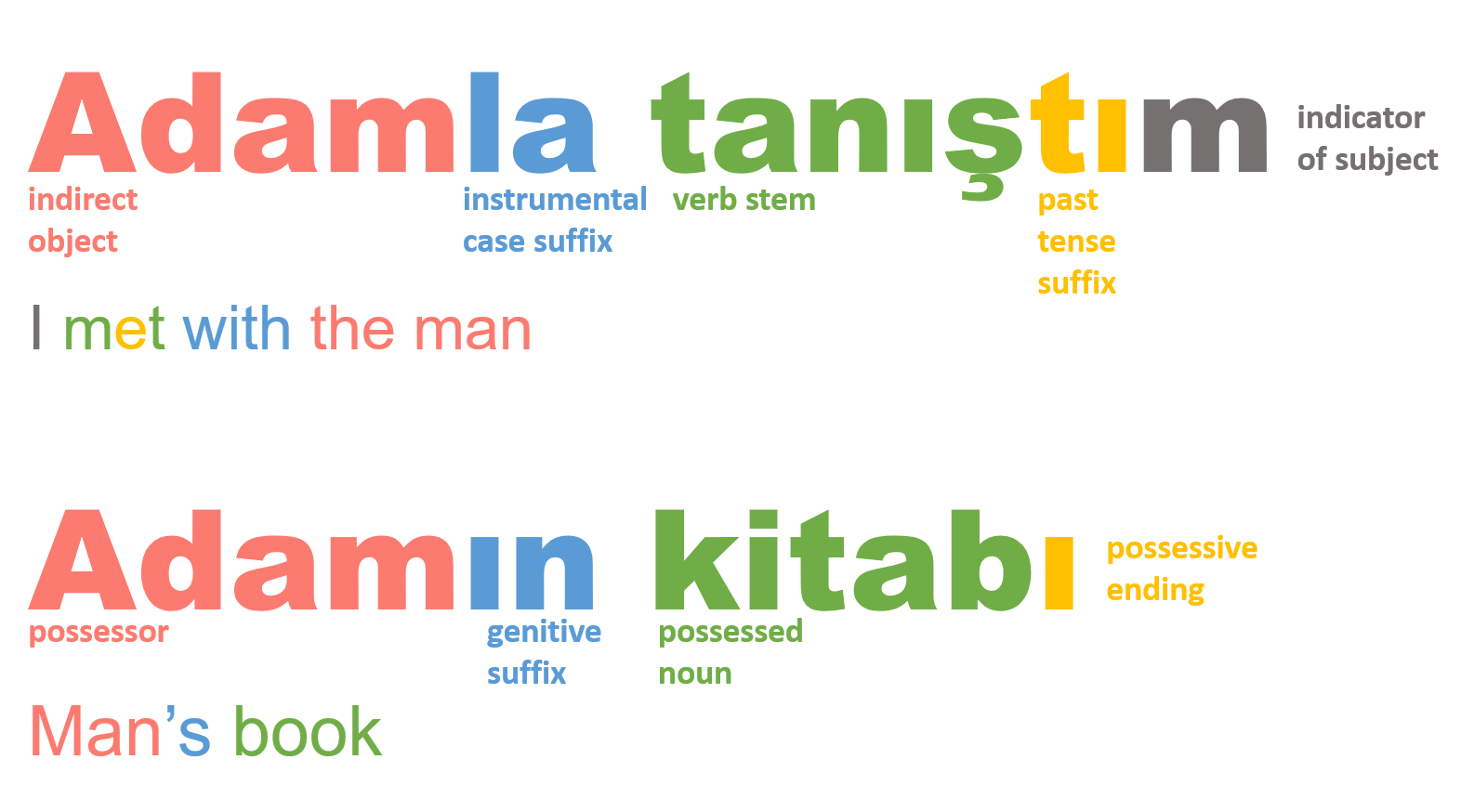
Unlike analytic languages, synthetic languages employ inflection or agglutination to express syntactic relationships.  combine one or more morphemes into one word. The distinguishing feature of these languages is that each morpheme is individually identifiable as a meaningful unit even after combining into a word. Examples of agglutinative languages include Tamil, Secwepemc, Turkish, Japanese, Finnish, Basque and Hungarian. Figure 3.3 shows you an example of agglutination in Turkish. Each coloured morpheme is also given an approximate English translation. Figure 3.2 give another example from Tamil.

image description linked to in caption
Figure 3.3 Example from Turkish, an Agglutinative Language [Image description]

Another type of synthetic languages are . Like agglutinative languages, fusional languages also combine morphemes to modify meaning. However, these combinations often do not remain distinct and fuse together. In addition, these languages also have a tendency to use a single inflectional morpheme to denote numerous grammatical or syntactic features. For example, the suffix -í in Spanish comí (“I ate”) denotes both first-person singular agreement and preterite tense. Examples of fusional languages include Indo-European languages such as Sanskrit, Spanish, Romanian, and German. Modern English could also be considered fusional; although it has tended to evolve to be more analytic. J. R. R. Tolkien’s fictional language Sindarin is fusional (another elvish language, Quenya, is agglutinative).

Figure 3.2 shows an additional morphological type named . These languages tend to a high morpheme-to-word ratio as well as regular morphology. They often combine a large number of morphemes to form words that are the equivalent of entire sentences in other languages. Many languages in North America such as Mohawk tend to have this type of morphology.

3.3 Morphology of Different Languages – Psychology of Language

.

.

.