Showing posts with label visuals. Show all posts

Wednesday, 17 December 2025

bridget riley, artist

At 94, the British artist Bridget Riley has a lot of work to show - and she has two shows on at the moment: Exhibition Bridget Riley Point de départ | Musée d'Orsay in Paris and Bridget Riley: Learning to See | Turner Contemporary in Margate, an hour from London on the coast.

Bridget Riley | Check it out from the DISD Library | DI Library | Flickr

Here's a super documentary on Bridget Riley - Painting the Line (BBC):

With exclusive behind-the-scenes access, seldom-seen footage from the archives, insights from admirers, experts and contemporaries including Tracey Emin, Michael Craig-Martin and Martin Freeman, and a revealing interview by Kirsty Wark, this is the story of a true visionary of British art. 
Bridget Riley has been challenging our perception through painting for over 60 years, with radical work that has transformed how we look at art and invites us to feel with our eyes. With simple black and white geometric shapes, repeated curves of colour or an array of muted dots, Riley’s work moves, shimmers and - in some cases - unsettles. 
At the age of 90, Bridget Riley shows no signs of stopping. Her paintings command millions at auction, she has won prestigious awards and honours, and continues to innovate, paint, publish and exhibit around the world. BBC cameras have filmed with Riley over the past few years in two of her studios, on the cliffs of Cornwall, where she spent the Second World War, and at the National Gallery in London during the installation of her enormous mural there in 2018. 
In a rare and revealing interview with Kirsty Wark, Riley dispels the numerous misconceptions which have followed her throughout her career. Many consider her as a poster girl for the Swinging 60s, while others hail her as a titan of abstract art. However, Riley considers herself a traditional painter who has merely picked up the baton from those who have gone before her, such as Leonardo da Vinci, Monet, Cezanne and Matisse.

Finally, here's the Bridget Riley | Homepage

.

.

.

Tuesday, 2 December 2025

cornelia parker, artist

From the Science Museum we looked at how art and nature interact:

discover how we have questioned our relationship with society, our bodies, the environment and found patterns in nature, as we continue to interpret and explore the world around us.

Another way of looking at the world could be how we see sheds - those little huts in the garden where we leave and forget lots of stuff:

or perhaps you prefer your sheds to explode...

which takes us to a reconstructed barn

A good place to see art in London is the Royal Academy summer exhibition

There is some great art happening, including from Yinka Shonibare, artist - whose work, as with many artists, is interesting to be seen next to others...

Including Cornelia Parker, also at Tate Britain in London - and New Zealand's City Gallery reopening with a bang with a major Cornelia Parker exhibition.


Cornelia Parker's 'Cold Dark Matter: An Exploded View’ (1991). SUPPLIED / Courtesy Tate Collection

These are brilliant ideas from Cornelia Parker - giving us Art from Destruction as seen in this recent video.

Finally in a new documentary from the BBC, In My Own Words, Cornelia Parker looks back over her extraordinary life and career.

.

.

.

Friday, 12 September 2025

language distance

In many ways, we can see why English is so different from other languages. It's a mixture of other languages and its grammar has been greatly simplified

It can be very interesting to compare English with, say, Chinese. Do you see any similarities with your langauge? Language differences: English - Chinese

From an English-speakers perspective, there are 'difficult' languages. How do these compare with yours Most Difficult Language To Learn

... And there are the 'easy' languages: Easiest Foreign Languages To Learn - Business Insider

This is what we can 'language distance' - and there is a useful guide from Gill Ragsdale on how language distance shapes fluency in the E L Gazette:

The ‘language distance’ between English and a language learner’s first language affects reading fluency, but not comprehension according to a study by Victor Kuperman at McMaster University, Canada. Gill Ragsdale reports.

Clearly it is easier for someone to learn a language that is more like their native language than one that is more distant: learning English is generally easier for Italian than for Japanese speakers. What is less clear is which processes in language learning are affected and how to quantify those effects.

Kuperman set out to clarify the effect of language distance on reading fluency and comprehension. Past studies have given mixed results, possibly because the focus has been on comprehension, which is relatively easy to measure.

Data for this study was taken from the Multilingual Eye-movement Corpus. This database has measures of reading fluency and comprehension from 1,105 students and staff from 24 universities having 18 distinct first languages.

For more, see: How does language distance affect reading fluency and comprehension in English as second language? by Victor Kuperman.

And: Linguistic distance - Wikipedia

Plus the discussions on Language distance in Europe : r/languagelearning

Monday, 18 November 2024

adventures in art at the british museum

The BBC radio series in conjunction with the British Museum threw up all sorts of exciting objects, each with their own fascinating back story:

BBC Radio 4 - A History of the World in 100 Objects - Downloads

Let's look at some of their possibilities:

Throne of Weapons


BBC Radio 4 - A History of the World in 100 Objects, The World of Our Making (1914 - 2010 AD), Throne of Weapons

Which is a reminder of this artist:

Jay Doubleyou: shonibare - gorgeously recognisable artist

Becoming an Artist: Yinka Shonibare | Tate Kids - YouTube

Yinka Shonibare MBE: FABRIC--ATION - YouTube

...

Hokusai's The Great Wave


BBC Radio 4 - A History of the World in 100 Objects, Mass Production, Mass Persuasion (1780 - 1914 AD), Hokusai's The Great Wave

Which takes us to:

John Berger / Ways of Seeing , Episode 1 (1972) - YouTube

...

Early Victorian tea set


BBC Radio 4 - A History of the World in 100 Objects, Mass Production, Mass Persuasion (1780 - 1914 AD), Early Victorian tea set

Which is a reminder of this again:

Jay Doubleyou: teaching empire in british schools

And what museums are doing with their imperial treasures:


Returning the Benin Bronzes - YouTube

Including the British Museum:

Benin plaque - the Oba with Europeans

BBC Radio 4 - A History of the World in 100 Objects, The First Global Economy (1450 - 1600 AD), Benin plaque - the Oba with Europeans

With another example from west Africa here:

Ife head


BBC Radio 4 - A History of the World in 100 Objects, Status Symbols (1200 - 1400 AD), Ife head

...

Finally, looking through the list, where would these objects take you?

BBC Radio 4 - A History of the World in 100 Objects - Downloads

Perhaps this?

Minoan Bull Leaper


BBC Radio 4 - A History of the World in 100 Objects, The Beginning of Science and Literature (1500 - 700 BC), Minoan Bull Leaper

Which might finish here:

Picasso and the Minotaur: Why Was He So Obsessed?

Exposición - Picasso Minotauro - Picasso, Pablo (Pablo Ruiz Picasso)


exploring picasso by eyesight and muscle memory | ballpoint,… | Flickr

And here:

PICASSO DRAWING OF BULL - YouTube

.

.

.

Tuesday, 30 April 2024

using design in the esol classroom

What is 'design'?

to make or draw plans for something that will be produced:
    Who designed your website?
to intend for a particular purpose:
    This dictionary is designed for people using English in a business situation.
the way in which something is planned and made:
    I don't like the design of this control panel.

DESIGN | English meaning - Cambridge Dictionary

Here's a useful framework:

Function & Form

Function relates to purpose. It answers the question, “why?” and defines the reasons you have to do something. Understanding function leads you to consider the necessary preconditions or assumptions for an activity and the desired outcomes. The 5 Whys is an excellent exercise for surfacing the function.

Form is the visible shape or configuration of something. It encompasses the methods and strategies. Form answers the questions of “what?” and “how?” After clarifying the function, form fills in the details and plan for how to realize the purpose.

Form or Function... - Everyday Design

For example:

Porsche Design staged by Hollywood - YouTube

Here's another approach:

Design Thinking is a term adapted from architecture and engineering and is often referred to as a “toolkit for innovation”. Its framework can be applied across a wide range of fields and its approach adapted to suit the needs of the user.

It involves 5 key stages – Empathize, Define, Ideate, Prototype and Test. This approach is most effective when addressing problems that are unknown or ill-defined. In the language learning classroom design thinking can help bridge the gap between creative problem solving and structured learning. It gives teachers additional tools to build understanding and provide students with frameworks for critical thinking and problem solving.

Design Thinking in the ESL Classroom | by Rishma Hansil | Medium

And here are some more suggestions:

Design Thinking Activities in the ESL Classroom | Express Publishing

Teacher's Corner: A Story of Design Thinking in the Classroom | American English

With a video:

How Design Thinking can be applied in language teaching? | Ms. ESL

There are very broad areas to look at:

ESOL: Speaking About Art - The Courtauld

And:

Jay Doubleyou: advertising

Jay Doubleyou: architecture

Jay Doubleyou: dismaland from banksy

Jay Doubleyou: land art

And check out these pages in the search facility:

Jay Doubleyou: design

Finally, back to design:

A design presentation | LearnEnglish

.

.

.

Wednesday, 31 January 2024

of time lines and duration: the language and philosophy of time

TENSE VS ASPECT:

The English language (but not only the English language) does not really have a 'tense system' for its verbs: rather, it's all about aspect, whether the continuous/progressive aspect or the perfect aspect:

Each verb tense represents a different subjective view of time, and all of the different uses of a particular verb tense can be connected back to this same view. For example, the present perfect can be used in a number of different situations, but all the usages have a unifying characteristic - each use indicates that the speaker is looking back at a past event from the perspective of the present.

Jay Doubleyou: grammar workshop

There are two tenses in English, the ‘present’ and ‘past’ tense; these are the only verbs forms that do not require an auxiliary. We add further meaning and viewpoints to these basic forms through the use of aspect. Aspect allows the speaker to interpret the events being described and express how they view them.

Tense vs aspect – Collins

With much more here:

Grammatical aspect - Wikipedia

And here we get into very complex territory:

Tense and Aspect (Stanford Encyclopedia of Philosophy)

...

TIMELINES AND TABLES:

To what extent, then, can we rely on what the grammar books show us?

The following are the norm - but are really not helpful as they do not reflect how the English language is used - or, indeed, how humans perceive the flow of time (see below):


All the English tenses, timeline


Verb Tense Timelines - Learn English Grammar

The problem with these schemes is that they don't represent the way the English language represents time.

English is not Latin - or a Latin language - with its very fixed table of tenses:

How English became English – and not Latin | OUPblog

There is no future tense in English:

Why doesn't English have an inflected future tense? When did such a tense last appear in the history of the English language, or if it never existed during the process from the PIE to English, where did it come to Latin from? - Cult of Linguists - Quora

But, then, philosophically, we can say that the future is not a reality - and is only something seen from the present. Again, a question of aspect:

Jorge Luis Borges Quote: “The future has no other reality than as present hope, and the past is no more than present memory.”

For example, the 'going to' form is not a 'future form' any more that 'want/hope/plan' to are. The 'going to' form is an exact mirror image of the present perfect - looking forwards from now, rather than looking backwards from now:

Joel Swagman (Reviews / TESOL): The English Verb by Michael Lewis

"What's wrong with grammar teaching ?" - Persée

...

THE PHILOSOPHY OF TIME:

A lot of this confusion has to do with how we perceive 'time' - and there are many different ways to do that:

Two contrasting viewpoints on time divide prominent philosophers. One view is that time is part of the fundamental structure of the universe – a dimension independent of events, in which events occur in sequence. Isaac Newton subscribed to this realist view, and hence it is sometimes referred to as Newtonian time.[46][47]

The opposing view is that time does not refer to any kind of "container" that events and objects "move through", nor to any entity that "flows", but that it is instead part of a fundamental intellectual structure (together with space and number) within which humans sequence and compare events. This second view, in the tradition of Gottfried Leibniz[17] and Immanuel Kant,[48][49] holds that time is neither an event nor a thing, and thus is not itself measurable nor can it be travelled.

Time - Wikipedia

Arrow of time - Wikipedia

Eternalism (philosophy of time) - Wikipedia

Philosophical presentism - Wikipedia

Philosophy of space and time - Wikipedia

And we can get really quite deep into all of this:

Time (Stanford Encyclopedia of Philosophy)

The Experience and Perception of Time (Stanford Encyclopedia of Philosophy)

...

DURATION

This is an understanding of time which 'goes against' the science of Newton (and Einstein) but which seems to accord with how humans (and other creatures?) see time: again, it's a question of aspect:

Duration (French: la durée) is a theory of time and consciousness posited by the French philosopher Henri Bergson. Bergson became aware that the moment one attempted to measure a moment, it would be gone: one measures an immobile, complete line, whereas time is mobile and incomplete. For the individual, time may speed up or slow down, whereas, for science, it would remain the same.

Duration (philosophy) - Wikipedia

Our temporal experience of the world is not divided into a series of neat segments, yet that's how we talk about time.

Why philosopher Henri Bergson rejected the word "time" - Big Think

Melvyn Bragg and guests discuss the French philosopher Henri Bergson (1859-1941) and his ideas about human experience of time passing and how that differs from a scientific measurement of time, set out in his thesis on 'Time and Free Will' in 1889. He became famous in France and abroad for decades, rivalled only by Einstein and, in the years after the Dreyfus Affair, was the first ever Jewish member of the Académie Française. It's thought his work influenced Proust and Woolf, and the Cubists. He died in 1941 from a cold which, reputedly, he caught while queuing to register as a Jew, refusing the Vichy government's offer of exemption.

In Our Time - Bergson and Time - BBC Sounds

We don’t really experience life as a succession of separate conscious states, progressing along an imaginary line. Instead, we feel time as a continuous flow, with no clearly demarcated beginnings and ends. We should not therefore confuse an abstract, arbitrary notion of practical convenience with the underlying truth that is continuously confirmed by our own experience.

Henri Bergson and the Perception of Time | Issue 48 | Philosophy Now

.

.

.

Tuesday, 25 April 2023

your country's icons

What's an icon?

ICON | English meaning - Cambridge Dictionary

Urban Dictionary: icon

What's a country's icons?

A national symbol may be any object, sign, or emblem that carries additional meaning and represents a cultural or political nation. It is a basic element of national identification and communication, and of national action. The meanings of national symbols may evolve and be replaced, being invoked, or indeed constructed, in their political, social, and cultural application. As a rule, they are closely associated with the real or invented tradition of the “imagined order” of the nation, or are at least related to it...

National symbol — Brill

What are your country's icons?

National symbol - Wikipedia

Here are some possibilities:

National symbols of England - Wikipedia

National Symbols| National Portal of India

Mary Queen of Scots as Feminine and National Icon: Depictions in Film and Fiction

Wilderness Society | National icon: the koala

Danish national icon - the lightweight men's four - World Rowing

.

.

Tuesday, 6 September 2022

powerpoint karaoke

Karaoke is a good way to learn English:

Jay Doubleyou: more learning through music: lyrics training

Jay Doubleyou: listening to song lyrics will help your pronunciation

PowerPoint Karaoke is another thing:

PowerPoint karaoke - Wikipedia

Which evolved from yet another thing:

PechaKucha - Wikipedia

Powerpoint Karaoke (also called Powerpoint Roulette or Battledecks) is an improv game where you give a presentation from a slide deck you’ve never seen.

Powerpoint Karaoke

For example:

Free PowerPoint-Karaoke slides

Topic 1: Dolphins (12 slides) 

Topic 3: Diet (11 slides)

The PowerPoint-Karaoke Game | SlideLizard®

Here are a few more:

PowerPoint Karaoke

And here we go!!

Slidefest | Powerpoint Karaoke Reinvented

.

.

.

Wednesday, 30 June 2021

the pavement surgeon

Throughout his home city of Lyon, Ememem is known as “the pavement surgeon.” The artist repairs gouged sidewalks and splintered facades with colorful mosaics that he describes as “a poem that everybody can read.” Intricate geometric motifs laid with pristine tiles hug the cracks and create “a memory notebook of the city. It reveals what happened, the life in these public places,” he tells Colossal. “Here cobblestones have been picked up and thrown. There a truck from the vegetable market tore off a piece of asphalt…”

© Ememem, shared with permission

Ememem’s first mosaic dates back 10 years when he found himself in a damaged alley in Lyon. At that time, he already was working in ceramic and translated that practice to revitalizing the outdoor area. Since 2016, he’s been consistently filling potholes and other divots throughout France. “It’s a succession of a lot of places and reflections, experiments I did before. I had done similar things, with other techniques, other supports, and finally, when this one emerged, I knew I found something that I was going to keep doing for the rest of my life,” he says.

Ceramic Mosaics Mend Cracked Sidewalks, Potholes, and Buildings in Vibrant Interventions by Ememem | Colossal

More photos to be seen:

swag — Artist, Ememem, mends cracked sidewalks, potholes…

And more fabulous stuff here:

Street Artist Transforms Cracks in the Pavement Into Gorgeous Mosaics

Here are his social media:

Born on a damaged sidewalk in 2016, Ememem is one of those sons born out of the asphalt who has disorder running through his blood. His sidewalk’s plasters, now emblems of the cityofLyon, start spreading all over Europe, according to the wandering of his worn out shoes! In arts events or undercover by the light of the street lamps, Ememem patches up the broken asphalt and inserts doors toward wonderland.    His terrestrial works of art, called «flacking»  from the french word «flaque» (puddle) let a glimpse of light through our homogeneous pavements which entombed our cities. 

Ememem street art

Ememem | Facebook

.

.

.

Thursday, 3 December 2020

some rappers have a larger vocabulary than shakespeare or melville

"Designer Matt Daniels looked at the first 35,000 words of artists’ rap lyrics — and the first 35,000 words of Moby-Dick, along with 35,000 words from Shakespeare’s plays — to compare the size of their vocabularies. He found that some have bigger vocabularies than Shakespeare or Melville. Of course, vocabulary size isn’t the only measure of artistry. But it’s an interesting look at how English has changed."

25 maps that explain the English language - Vox


The Largest Vocabulary in Hip Hop

Largest vocabulary in hip hop uses more unique words than Shakespeare

Data scientists reveal the rappers that have a better vocabulary than Shakespeare | indy100 | indy100

The Best Infographic for Comparing Rapper Vocabularies, From Wu-Tang to Yeezy | WIRED

.

.

.

Friday, 27 November 2020

what's the english 'word of the year' for 2020?

 Susie Dent is a lexicographer:

Lexicography - Wikipedia

And she has quite a following:

Susie Dent (@susie_dent) / Twitter

She appears on TV: 

Susie Dent - Countdown 27/08/2020 - HD - YouTube

And she has a regular newspaper column:

Susie Dent | Latest news, analysis, and comment from the i paper

This is her latest piece: on what should be the 'new word of the year':

Covid-19, BLM, anthropause — Oxford Dictionaries is right that there could be no single word of the year

Language is one of the most powerful mirrors of our preoccupations you can find

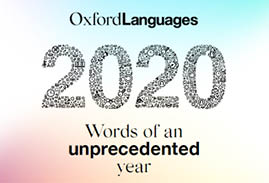
By the end of April, the Word of 2020 looked to be a slam-dunk already. “Unprecedented” had become the adjective that none of us could avoid, nor ever seem to find a suitable synonym for. Game over, surely?

And yet it would also describe Oxford Dictionaries’ final choice for its ever-anticipated Word of the Year, announced today, because, for the first time, they have found it impossible to choose one. 

Like us, language has had to deal with a barrage of new realities in 2020, and to adapt not just once, but repeatedly. And so Oxford concluded that this year, uniquely, the scope and the scale of change couldn’t possibly be encapsulated in a single term. Instead they have presented an array of words whose usage graphs have spiked in 2020. From “conspiracy theory” to “anthropause”, the result is not a snapshot, but a linguistic panorama.

...

Covid-19, BLM, anthropause — Oxford Dictionaries is right that there could be no single word of the year

Here's the Oxford Dictionary's own website:

Oxford Word of the Year 2020 | Oxford Languages

Word of the Year | Oxford Languages

.

.

.

Wednesday, 11 December 2019

pecha kucha: "talk less, show more"

The power of using the right images in the classroom...

What is PechaKucha?

PechaKucha’s 20x20 presentation format shows your 20 chosen images, each for 20 seconds. In other words, you've got 400 seconds to tell your story, with visuals guiding the way. PechaKucha means "chit chat" in Japanese. This creative outlet began as nighttime get-togethers in Tokyo in 2003 by two renowned architects. Since then, three million people have attended PechaKucha events worldwide. Read more.

Pecha Kucha 20x20: Discover Pecha Kucha presentations, stories, ideas, examples, and videos that will inspire

For example:
Francisco Martínez Architecture & Community Video Presentation: Makers Make

Inspired by their desire to "talk less, show more," Astrid Klein and Mark Dytham of Tokyo's Klein-Dytham Architecture (KDa) created PechaKucha in February 2003.[2][3]
PechaKucha - Wikipedia

For example:
How to Make Great Presentations the Pecha Kucha Way
A Pecha Kucha about Pecha Kucha - YouTube

Great for the classroom!

.

pecha-kucha in the classroom - YouTube

A final couple of examples:
Pecha Kucha - Flipping Your Classroom (STLHE 2016) - YouTube
Pecha Kucha: Teaching and Learning - YouTube
.
.
.