Showing posts with label speaking skills. Show all posts

Tuesday, 31 March 2026

Wednesday, 25 March 2026

language cafés

A lot of universities offer language cafĂ©s - which are free and open to the public.

For example, at Language Community | Language Centre | University of Exeter

Every week in terms 1 and 2, the University of Exeter holds Languages CafĂ© sessions on campus which are open to all its students, staff and members of the public. All levels of ability are welcome, and there is no need to book or prepare in advance – just turn up!

The Languages Cafe is:A great way to meet people at the University of Exeter and improve a language in a fun and relaxed way.

  • An opportunity to promote intercultural communication and give language learners, practitioners, and enthusiasts an opportunity to converse informally in their chosen language.
  • Open to anyone at the University of Exeter (students and staff) and members of the public.
  • Free of charge.
  • Beneficial whatever your language level. All you need is the enthusiasm to learn a foreign language and to meet people from across the world.
Languages on offer have included French, Spanish, Italian, English, Arabic, Mandarin, British Sign Language, Russian, Japanese, and Portuguese; but others be added if there are two (or more) speakers of the same language on that day.

In Stockholm, these are called KonversationscafĂ© Stockholm - for example: Language Cafes - Stockholms universitet

They're also called SprĂ„k cafe?:

Looking at the website for Stockholm's libraries it looks like there are around 5-6 sprÄkcafé events at the libraries around the city every day, so plenty to choose from.

We also have the Sprachstammtische Muenchen, for example Language Exchange in Munich - Meet up for Conversation and English-German-Stammtisch Munich | Meetup

Finally, though, probably the best way to find a group to practice your English or any other language is via social media, such as Language Tandem MĂŒnchen | Facebook

Good luck finding something - and have fun!

.

.

.

Thursday, 12 March 2026

improve your speaking skills: find a speaking partner

How can we improve our speaking when learning another language? 

Very formalised exercises can help, such as doing practical dictation with online texts and audio, which will help us focus on good spoken English.

There's a less controlled way to stimulate talk - and one would be using video podcasts for listening and to generate speaking.

And Robbie from EnglishHarmony suggests we talk to ourselves to increase fluency and self-confidence.

We can even try practising our English speaking with ChatGPT.

But we can find real people to talk to - and through the website 'Conversation Exchange' - finding a speaking partner online is pretty easy.

There are lots of apps and websites for language partners - but the question remains: How do you find consistent language exchange partners? And the answer tends to be: "Sadly you have to pay someone to be consistent."

However, there are ways to find a speaking partner...

The online teacher Katie has some very practical ideas on How to find a partner for speaking practice - and talking to another "non-native" at least gets you developing your fluency and confidence, as Katie says:

1. First, you should try asking all your friends if they are interested. It’s very likely that you have a friend who is learning English or maybe you can find a friend of a friend. This is probably the easiest way.

2. The second easiest way is perhaps to try social media. You can find other people who are looking for a partner on Facebook, Instagram, YouTube, Reddit and many more. I have a Facebook group which you can join.

3. Don’t just look at social media pages for learning English. What are your other hobbies and interests? Join groups and follow pages related to your hobbies where the conversation is in English and join in!

And others have similar ideas - such as 9 Unexpected Places To Find Real-Life Language Partners by Fluent Language

.

.

.

Friday, 3 October 2025

Lexical Lab: learn languages with an online teacher through everyday english and common words, chunks, idioms, phrasal verbs, phrases and expressions used in spoken language

Experienced teachers Hugh Dellar and Andrew Walkley have put together an online learning and teacher-training platform: Language Learning and Teacher Development | Lexical Lab

As this intro video says, it "looks at everyday English and common words, chunks, idioms, phrasal verbs, phrases and expressions used in spoken English".

Yes, it's using the lexical approach to learning a language!

There are very positive opinions about the site and service: Lexicallab Reviews | Read Customer Service Reviews of lexicallab.com.

They've got a blog.

And they've got a mailing list.

Looking at more about Lexical Lab, we learn that:

We have written one five-level General English coursebook series: Innovations, which was nominated for ESU award and two ELTons, and one six-level series, Outcomes, which is now in its third edition and has received widespread acclaim.

As trainers and methodologists, we have been strongly influenced by lexical views of language and by practice derived from lexical approaches to language. This led us to write a methodology book, Teaching Lexically, part of Delta Publishing’s multi-award-winning teacher development series.

To finish, here's the Hugh Dellar Interview - Teaching Lexically, Lexical Approach LEGEND! - YouTube

.

.

.

Tuesday, 30 September 2025

clichés, pragmatics and how we use language to connect us beyond the actual words used

What is the purpose of language? Do words carry meaning? Is language communication?

These are questions Michael Rosen looks at in his excellent weekly programme on BBC Radio 4 - and this week, it's: Word of Mouth - It's not what you say, it's how you say it - BBC Sounds

Michael Rosen on the linguistic comfort food of clichĂ©s, pragmatics and how we use language to connect us beyond the actual words used. Derek Bousfield explains how words do more than carry meaning: context governs what we say and how it’s understood. Dr Bousfield is Reader in Pragmatics and Communication and Co-Director of The Manchester Centre for Research in Linguistics and co-author of Talking in ClichĂ©s: The Use of Stock Phrases in Discourse and Communication.

They look at Pragmatics - how we say things beyond what they literally mean - for example "How are you?" is not asking about your health/problems: Jay Doubleyou: pragmatics: it ain't what you say it's the way that you say it

Language is not literal! Especially in conversation, which is guided by culture and context.

Language is non-direct - for example: "Why don't we have a coffee some time?" is not making a specific arrangement to meet. Another example: "We'll see how it goes" means I don't agree with you but I don't want to talk about it any more. 

The British love understatement or litotes - which are codes to build rapport.

There is the world of clichĂ©s - and comedians such as Peter Kay enjoy playing with them. We use them all the time to connect people -  and that "we are all on the same page", to use a clichĂ©.

We live by metaphors: Metaphors We Live By - Wikipedia [metaphor is a tool that enables people to use what they know about their direct physical and social experiences to understand more abstract things like work, time, mental activity and feelings.] and Metaphors We Live By: George Lakoff and Mark Johnson - YouTube [Lakoff and Johnson argue that metaphors aren’t just poetry, but a fundamental part of our brain conceptual system. That is, they’re central to the way we perceive ourselves, others, and the world.]

A favourite example from Prof Bousfield is 'literally': Urban Dictionary: literally

And a favourite from Michael is 'the bottom line': BOTTOM LINE definition and meaning | Collins English Dictionary and What does ‘bottom-line’ mean here? : r/EnglishLearning

The word 'clichĂ©' comes from French: ClichĂ© - Wikipedia

To finish this look at the programme, here's Derek Bousfield's book: Talking in ClichĂ©s: The Use of Stock Phrases in Discourse and Communication: Amazon.co.uk: Bullo, Stella: 9781108458139: Books

For decades, social perspectives, and even academic studies of language, have considered clichĂ©s as a hackneyed, tired, lazy, unthinking and uninspiring form of communication. Authored by two established scholars in the fields of Systemic-Functional Linguistics and Discourse Studies and Pragmatics, this cutting-edge book comprehensively explores the perception and use of clichĂ©s in language from these complementary perspectives. It draws data from a variety of both written and spoken sources, to re-interrogate and re-imagine the nature, role and usage of clichĂ©s, identifying the innovative and creative ways in which the concepts are utilised in communication, interaction, and in self-presentation. 

Observing a rich, complex layering of usage, the authors deconstruct the many and varied ways in which clichés operate and are interdependently constructed; from the role they play in discourse in general, to their functions as argumentative strategies, as constructs of social cognition, as politeness strategies, and finally as markers of identity.

And here's a look or two at clichés:

What is a cliché? Check out this list of examples.

SUPER IMPORTANT EXPRESSIONS | Clichés in Spoken English - YouTube

See also:

Jay Doubleyou: pragmatics

Jay Doubleyou: juergen habermas: communicative rationality and deliberative democracy

Jay Doubleyou: ambiguity is everywhere in englsh

Jay Doubleyou: behaviourism >>> krashen... pinker... skinner... chomsky

Jay Doubleyou: small talk, phatic communication and the games people play

Jay Doubleyou: english is not transparent

Jay Doubleyou: writing with register: a lesson in using different levels of 'politeness'

Jay Doubleyou: what is 'politeness' and how can we teach it?

.

.

.

Thursday, 18 September 2025

musical rhythm and learning a language

What's the relationship between music and language?

Jay Doubleyou: it ain't what you say, it's the way that you say it: intonation and functional language

In a piec on tuning the brain to language in he latest E L Gazette, Gill Ragsdale looks at how "research reveals that musical rhythms matching a language’s natural beat can significantly enhance how the brain processes speech, strengthening the case for rhythm-based teaching":

Musical rhythm may boost the processing of speech in the brain—but only when the rhythm matches the language, according to new research from the Basque Center on Cognition, San Sebastian, Spain, by Laura FernĂĄndez-Merino and colleagues.

The positive impact of musical training on language learning and proficiency is well-documented but the neural processes underpinning this effect remain mysterious. Both language and music are human universals found in every culture around the world and this study focussed on something shared by both: rhythm.

Here's the original research: Human Brain Mapping | Neuroimaging Journal | Wiley Online Library

These ideas have been around for a long time, whether in the mainstream media: Feel the beat: how rhythm shapes the way we use and understand language | Languages | The Guardian

Or in the industry: How Musical Rhythm Can Aid with Learning | The Science of Sound for Kid's - Holiday and Term-Time

Here's a view from a psychologist: The Relationship between Music and Language

And to finish, here are a cuople of TED Talks: 

Music as a Language: Victor Wooten at TEDxGabriolaIsland - YouTube

Interplay Of Music, Language, And Emotion In The Brain | Julia Howe | TEDxLickWilmerdingHS - YouTube

.

.

.

Wednesday, 16 July 2025

practising your english speaking with chatgpt

Whilst integrating IT into teaching, learning, and assessment will require careful consideration, we will be using AI more an more in language acquisition.

For example, there has been a lot of research into the use of Chat GPT in teaching/learning/working with English. And on a practical level, we can ask AI if they can give me a lesson plan!

Finally, whilst language is indeed a human thing, we are increasingly able to have pretty good 'conversations' with AI bots.

As the AI Overview on Google suggests:

To interact with ChatGPT, you can type your prompts into the text box or use the voice conversation featureOn the mobile app, you can find the microphone icon to speak your prompts. On the web version, you can enable voice conversations in the settings and use the microphone icon or voice mode button to talk to ChatGPT. 
Here's a breakdown of how to talk to ChatGPT:
1. Using Voice on the Mobile App:
  • Open the ChatGPT app and locate the message box. 
  • Look for the headphone-shaped icon or the voice waveform icon on the right side of the text box. 
  • Tap the icon to activate voice input and choose your preferred voice from the available options. 
  • Start speaking your prompts, and the app will automatically detect the end of your sentences. 
  • To end the conversation, you can tap the circular button with a cross in the middle of the screen. 
2. Using Voice on the Web:
  • Go to ChatGPT.com. 
  • If it's your first time using advanced voice, you may need to grant browser permission to access your microphone. 
  • Locate the voice icon on the bottom-right of the screen and click on it. 
  • Choose your preferred voice and begin speaking your prompts. 
  • You can also use the microphone icon to enter your prompt using voice-to-text. 
3. Typing Prompts:
  • Regardless of whether you are using the app or the web version, you can always type your prompts into the message box. 
  • After typing your prompt, press enter or the send button to send it to ChatGPT. 
Key points to remember:
  • Speak clearly and concisely when using voice input. 
  • ChatGPT can handle ongoing conversations, so you can refer to previous prompts. 
  • You can refine your prompts by using follow-up questions or by providing additional context. 
  • Experiment with different prompts and approaches to find what works best for you. 

how to talk to chatgpt - Google Search

With more suggestions here from Reddit:

Talk to ChatGPT on computer : r/ChatGPTPro

Speaking practice with ChatGPT/AI : r/dreamingspanish

With some video ideas too:

Use the ChatGPT App as an English Practice Partner - YouTube

How to Practice Your English LIVE with ChatGPT - YouTube

How I make ChatGPT my English SPEAKING Partner - YouTube

ChatGPT training to practice English | 2025 - YouTube

Finally, here's the bot itself:

ChatGPT - English Speaking Practice GPT

.

.

.

Thursday, 10 April 2025

how to get more fluent: keep it short and simple

The key to getting your English more fluent-sounding is to get the sounds right:

Jay Doubleyou: it ain't what you say, it's the way that you say it: intonation and functional language

And a great way to get your English sounding more natural is to mimic what you hear:

Jay Doubleyou: how to get the shadowing technique right

Robbie of English Harmony in Ireland has got some great tips on how to sound more fluent:

Jay Doubleyou: english harmony

And he says we need to keep things short and simple - as does the latest research from Japan, as covered by the E L Gazette:


Fluency sounds smoother with simple language, study shows - E L Gazette

.

.

.

Monday, 31 March 2025

code-switching: jumping between different registers, different voices and different languages

REGISTER:

We can communicate using different registers and different types of language, depending on the context - for example:

For formal and informal register; 'Would you mind passing the salt?' is appropriate for a formal situation with strangers, whereas 'Pass me the salt' would be used for a situation where friends are talking, or possibly when being rude.

Register | TeachingEnglish | British Council

Here's a good introduction:

Register: Language Formality in Creative Writing–#AuthorToolboxBlogHop – Words like trees

We need to be teaching and learning about it:

MultiBrief: Language register: What is it and why does it matter in education?

How Did That Register? Five Levels of Formality in Language | ALTA Language Services

Here are some of those different contexts:

Jay Doubleyou: writing about your holiday in different registers

Jay Doubleyou: register: populism, culture wars and woke

Jay Doubleyou: learning to use the appropriate register @ fawlty towers

Jay Doubleyou: writing with register: a lesson in using different levels of 'politeness'

Jay Doubleyou: high culture > popular culture --- high register > low register

It becomes much more difficult to change register or 'voice' in the middle of speaking or writing

Do native English speakers face difficulty in switching between registers?

CODE-SWITCHING:

We can call this 'code-switching':

Register and style: code-switching

Code-switching isn't just for bilingual people: Code-switching is switching between multiple different languages, dialects, and registers depending on the social situation the speaker is in.

Although we usually talk about code-switching in terms of switching languages, utilising different registers in communication is also considered code-switching. A teenager at school may talk to their friends and classmates using a casual register, then code-switch to a formal or consultative register when talking to their teacher.

Register and Style: Definition, Meaning & Examples | StudySmarter

It's quite a hot topic:

Code-Switching in Language | Definition, Types & Examples | Study.com

For example:

In popular usage and in sociolinguistic study, the term code-switching is frequently used to refer to switching among dialects, styles or registers.[9] This form of switching is practiced, for example, by speakers of African American Vernacular English as they move from less formal to more formal settings.[10] Such shifts, when performed by public figures such as politicians, are sometimes criticized as signaling inauthenticity or insincerity.[11]

Code-switching - Wikipedia

HETEROGLOSSIA:

Mixing up register/voice/language can go beyond the sociology and politics of language.

Here's an interesting idea: 'heteroglossia':

In literature it refers to different voices used within a text, so that might be the differentiation between characters and an omniscient narrator, or it could be different sociolects (class/regional etc dialects) represented by characters. Any time the speech of someone in the text tells you about who they are and how they're different to others in the text is an example of heteroglossia. In non fiction, the same applies, only the heteroglossia arises out of people's real differences rather than having to be invented by an author. Linguistic code in this context is deliberately vague, but does entail that the characters should be using mutually intelligible language. So, it might be two male characters that both speak English but one is poor and black and uses ebonics and one is rich and white and speaks a more formal, standardised way, or it could be two middle class people but the male uses more assertive language and the female is more passive.

Confused about 'heteroglossia' meaning : r/linguistics

With more from Wikipedia:

Heteroglossia is the presence in language of a variety of "points of view on the world, forms for conceptualizing the world in words, specific world views, each characterized by its own objects, meanings and values."[1] For Bakhtin, this diversity of "languages" within a single language brings into question the basic assumptions of system-based linguistics. Every word uttered, in any specific time or place, is a function of a complex convergence of forces and conditions that are unique to that time and place...

The hybrid utterance, as defined by Bakhtin, is a passage that employs only a single speaker—the author, for example— but uses different kinds of speech. The juxtaposition of the different speeches brings with it a contradiction and conflict in belief systems.

In examination of the English comic novel, particularly the works of Charles Dickens, Bakhtin identifies examples of his argument. Dickens parodies both the 'common tongue' and the language of Parliament or high-class banquets, using concealed languages to create humor. In one passage, Dickens shifts from his authorial narrative voice into a formalized, almost epic tone while describing the work of an unremarkable bureaucrat; his intent is to parody the self-importance and vainglory of the bureaucrat's position. The use of concealed speech, without formal markers of a speaker change, is what allows the parody to work. It is, in Bakhtin's parlance, a hybrid utterance. In this instance the conflict is between the factual narrative and the biting hyperbole of the new, epic/formalistic tone.

Bakhtin goes on to discuss the interconnectedness of conversation. Even a simple dialogue, in his view, is full of quotations and references, often to a general "everyone says" or "I heard that.." Opinion and information are transmitted by way of reference to an indefinite, general source. By way of these references, humans selectively assimilate the discourse of others and make it their own.

Heteroglossia - Wikipedia

Let's draw back to give a bit more context.

Here's a very readable look at all of this by Jena Barchas of the Everyday linguistic anthropology blog:

Words have flavors: indexicality, heteroglossia, intertextuality

Let me start with an obvious point: we all have boatloads of resources at our disposal for making meaning. Not just our words — we’ve also got our clothing, our posture, the way we walk — but for now, I’m mostly going to talk about words.

All these resources communicate through indexicality. Basically, they point to other meanings. Classically, smoke indexes fire: it doesn’t look like fire, but it points to it by means of long association. Of course, smoke could mean that there’s a smoke machine rather than a fire. But most of the time, it doesn’t.

When we talk about indexicality and language, we’re generally talking about different ways of saying the same thing, which carry different meanings.

For example:
Using a higher pitch indexes femininity. It doesn’t resemble a woman in any way, but it’s connected by regular proximity. When men want to make it clear that they’re imitating women, the first thing they do is raise the pitch of their voices.
If I stop someone on the street and ask them for the time, do I say, “Yo” or “Excuse me, sir”? In fact, both are correct — but they tell you different things about me, that person, and our relationship.
Speaking a particular language or dialect often indexes group affiliation.
Accents index a particular region.
Slang indexes a particular age, among many other personal characteristics.

In short, words have flavors.

Consider the word “dude.” These days, it indexes a sort of laid-back Californian vibe, in addition to heterosexual masculinity. It’s not a quotation from a specific original source, but it’s connected to a way of talking, a voice in the broadest sense.

Or consider the words “beget” and “Sabbath.” They’ve both got Judeo-Christian Bible flavor. “Wack,” “talk to the hand,” and “the bomb” have ’90s flavor. “Actionable” and “productize” have corporate flavor. “Occupy” indexes leftist politics and inequality — and it’s only done so for about five years.

As you can see, a single language — in this case, English — always contains multiple voices and varieties. And it doesn’t matter how self-contained and original a single stretch of language is; it contains elements that index various contexts, norms, and voices.

When we talk about this sense that language always contains multiple voices, we’re talking about heteroglossia (lit. “different voices”). (The term was coined by Russian literary critic Mikhail Bakhtin and promptly appropriated by linguistic anthropologists.)

We also often talk about a special case of heteroglossia, which we call intertextuality: the borrowing, quoting, or reworking of a recognizable (oral or written) text.

The movie Clueless is a reworking of Jane Austen’s Emma.
If I say “Accio pencil,” what am I referring to? What will you do? (I once heard a student say this in class, and another student picked up the pencil she’d just dropped.)
Internet memes often blend multiple texts, as do parodies.

So what? Why is this interesting?

Here’s why: both heteroglossia and intertextuality only work as devices if we can assume that some voices and texts are shared. “Accio pencil” is only meaningful if you’re also familiar with Harry Potter; this faux-mercial is only funny if you’ve seen this (real) commercial; a man raising the pitch of his voice to imitate his mother-in-law only makes sense if you share the knowledge that women have high voices.

Language isn’t homogeneous within a group of people, and language is never neutral. Heteroglossia makes visible our knowledge and assumptions of just how that diversity is organized.

Words have flavors: indexicality, heteroglossia, intertextuality | Everyday linguistic anthropology

Let's finish with a challenge to teachers in the classroom:

Dialogic education is a teaching method which is in stark contrast with monologic teaching methods. Nowadays, the educational systems all around the world characterize monologic education in which the ideas and voices of the teachers are the first and last ones uttered in the classrooms, textbooks are aimed so that students learn how to speak and write “correctly” and the time extent of the class is so short that teachers are struggling to cover all the “important” points mandated in the textbooks and by educational authorities. 

In contrast in dialogic education, the teacher shares his or her authority with the students; the voices of the students are heard and their opinions are valuable. In a dialogic class, the students are divided into groups to practice “exploratory talk” and “think reasonably”. The aim in discussing different opinions is just that; discussing different opinions not winning or losing. The role of the teacher is to facilitate the process; he or she is not a judge or referee, he or she is simply a guide. A dialogic environment is like a carnival; to borrow from Bakhtin. There are no omnipresent powers. 

The current study shows that different components of Bakhtin’s dialogism concept can be a very good starting point for a modern and effective theoretical framework for learning and teaching processes.

Dialogism versus Monologism: A Bakhtinian Approach to Teaching

.

.

.

Monday, 10 March 2025

different african english accents

Most Africans are bilingual:

In a cafe in south London, two construction workers are engaged in cheerful banter, tossing words back and forth. Their cutlery dances during more emphatic gesticulations and they occasionally break off into loud guffaws. They are discussing a woman, that much is clear, but the details are lost on me. It’s a shame, because their conversation sounds fun and interesting, especially to a nosy person like me. But I don’t speak their language.

Out of curiosity, I interrupt them to ask what language they are speaking. They both switch easily to English, explaining that they are South Africans and had been speaking Xhosa. In Johannesburg, where they are from, most people speak at least five languages, says one of them, Theo Morris. For example, Morris’s mother’s tongue is Sotho, his father’s is Zulu; he learned Xhosa and Ndebele from his friends and neighbours and English and Afrikaans at school. “I went to Germany before I came here, so I also speak German,” he adds.

Was it easy to learn so many languages? “Yes, it’s normal,” he laughs.

He’s right. Around the world, more than half of people – estimates vary from 60-75% – speak at least two languages. Many countries have more than one official national language – South Africa has 11. People are increasingly expected to speak, read and write at least one of a handful of “super” languages, such as English, Chinese, Hindi, Spanish or Arabic, as well. So to be monolingual, as many native English speakers are, is to be in the minority and perhaps to be missing out.

Why being bilingual works wonders for your brain | Language | The Guardian

Jay Doubleyou: ça va?! bilingualism is good for the brain

Much of Africa is Anglophone:

Jay Doubleyou: english is an african language

Jay Doubleyou: the english-speaking world: west africa

But each country and region has its own accent:

WHICH AFRICAN COUNTRY HAS THE BEST ENGLISH ACCENT - YouTube

KENYANS HAVE THE BEST ENGLISH ACCENT & PRONUNCIATION. DO SOUTHERN AFRICANS NEED TO RELEARN ENGLISH? - YouTube

Here is an excellent overview:

Accents of Africa | IDEA: International Dialects of English Archive

And here's a nice conversational view of being South African:

Language: Accents, dialects, and the Queen’s English - SPEAK Blog

Finally, here 


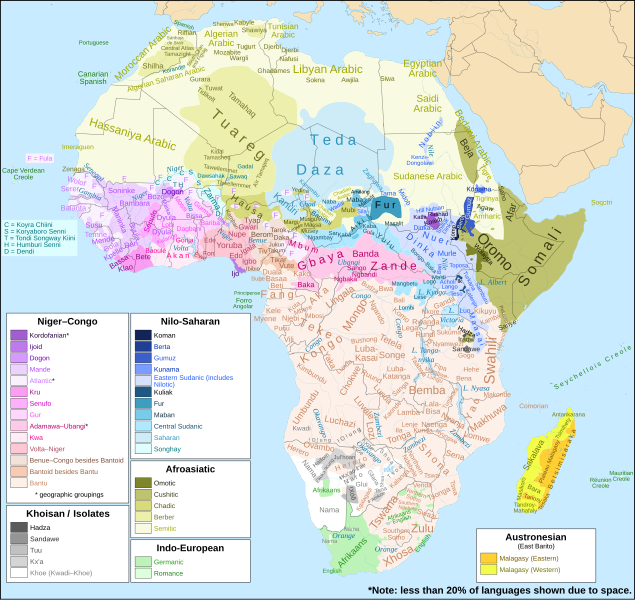
Languages of Africa - Wikipedia


635px-Map_of_African_languages.svg.png (635×600)

.

.

.

Friday, 7 March 2025

it ain't what you say, it's the way that you say it: intonation and functional language

INTONATION AND FUNCTIONAL LANGUAGE

'It ain't what you say it's the way that you say it.'

In focussing on 'getting the words right', both teachers and students often overlook the question of how intonation creates meaning.

Following on from a functional lesson ('telephoning') being observed, I'd like to consider how intonation interplays with functional language.

1) ADDING COLOUR: Once the notion of chunking has been firmly established, work on specific areas of intonation in connected speech:

(See: last chapters of 'Pronunciation Task's by Martin Hewings, CUP, for the basics)

Identifying stressed words/syllables:

dictionary work with 'schwa' for individual words prior to chunks unstressed forms of to/and/were - which are often the 'grammar words'! versus prominent words - which are normally the 'content' words rhythm in Whatdidhesay?/Yesofcourse/Whatdoyouearn?

Linking words together:

consonant+vowel - keepoffthegrass/putonyourclothes

assimilation, or some consonants changing nature - turnback!/Agoodpartybecomes = turmbackf/Agoopparty

vowel+vowel often needs /w/, /j/ or /r/ - Whoareyou?jTeaorcoffee?/Isthedooropen? elision, or the dropping of sounds - Canyouseehim/Ican'tunderstandher becomes Canyouseeim?/Icanunderstander

Students will be familiar with I'm/don't, but not that Areyoualright,mate? becomes ri'ma?

Mimicking the 'music' of the language:

Tonic words, or where there is a change in tone, normally indicate the prominent word -It'sontopofthebookcase or It'sontopofthebookcase

Rising tone can indicate what the listener already knows, whereas falling tone is 'news' - WhenareyougoingtoNewYork? (up = not sure) I'mflyingatteno'clock (down = I know)

Rising tone can also indicate that the speaker hasn't finished: the sound-scripted phone-call above would have rising tone at Canitakeamessaget and 'within' the phone­number

2) Students EXPERIMENT with intonation:

Students listen to clear and complete exponents and try them out themselves. PARROTING exactly what they hear - including pitch, pace, pauses, as above

Higher level students INTERPRET more varied exponents where intention and meaning are not clear. Content often contradicts use of voice:

Yes;. of course/I see. (When the speaker in fact doesn't agree)

Changing stress:

Idunno/Areyougonnago? becomes ldon'tknow/Areyougoingtogo

Whatdidyougetuptolastweek?/Wouldyoumindnotdoingthat,please?

Changing tone:

I'dliketo from down to up can show definite acceptance of an invitation to reservation

Wasitexpensive? from up to down can show curiosity to scolding

Really? from up-down to down-up

Work out with the students whether tone should be questioning or flatter

Changing function:

Trying to say a 'command' as a 'request' and vice-versa, whilst keeping the phraseology:

Iwaswonderingifyoucouldgivememycoat,please./Ablackcoffee.

Trying out different 'moods' to the same phrase, saying it weak/strong, pleading/demanding, authoritatively/patronisingly/sarcastically:

Canwegotothebeach?/Whydon'tyouloveme?

3) Start with the premise that most functional speech is made up of 'CHUNKS', that is, pieces of language which should be recognised as a single whole:

Could I have a cup of coffee?/I'll have the steak./Have you got any change?

Students should be given practice in saying these out loud - but as chunks: Repeating or reading these complete phrases as if they were one word.

Gaps in the wrong place would indicate hesitation:

CanlspeaktoJohn?/Wouldyoumindopeningthewindow?

Integrating set phrases into a complete conversation with correct pausing.

Speed does not equal fluency: it encourages students to blur chunks or stop mid-chunk. It'saboutnextWednesday. (pause.) I'msorrybutlcan'tmakeit (pause.) Canwemakeanotherdate? (pause.)

4) SOUND-SCRIPTING: Students take a ready-made audio script or a self-created conversation - then re-write it line by line. This can be done on a word-processor by pressing 'enter' at the end of each chunk to start a new line:

A: Hi.

Joehere. CanlspeaktoTim?

B: Sorry, He'snotin.

Canltakeamessage ordoyouwanttocallback?

A:Er

Canyoutakeamessage

ThisisJohn

Canhecallmebackon

01395

513

456?

It really does take off when students must ask themselves about both the appropriate phraseology to be adopted and the appropriate tone - depending on the role being played.

In other words, we are teaching our students to PLAY ROLES - to act out their lines convincingly - and 'with feeling'.

14th September 2008.

...

Here's the same but as images to download and photocopy:

.


.

.

.

Wednesday, 5 March 2025

teaching 'unplugged' twenty-five years on

Over the years, these pages have looked at 'teaching unplugged', the last time some six years ago:

Jay Doubleyou: the 'dogme' approach or 'teaching unplugged':

In fact, the idea started some twenty-five years ago:

Scott Thornbury came up with this approach in 2000, following on from an article he wrote questioning the reliance on coursebooks and other classroom staples.

What is the Dogme ELT approach or Teaching Unplugged? - English Lessons Brighton

Teaching Unplugged is the term used for a teaching method and philosophy which has three primary aims: teaching through conversation, taking out external input such as course book and technology and letting the lesson content be driven by the students rather than being pre-planned by the teacher. Based on the ‘Dogme ELT’ approach to teaching, its origins lie in an article written in 2001 by Scott Thornbury and Luke Meddings called ‘The roaring in the chimney’. They later wrote ‘Teaching Unplugged’, a comprehensive guide to this type of teaching and winner of the British Council ELTons award for Innovation in 2010.The ‘Teaching Unplugged’ or ‘Dogme ELT’ movement has a very strong following amongst teachers. In fact, Dogme ELT discussion list, which was originally set up in March 2000 by Scott Thornbury to help bring this style of teaching to the fore, has now been disbanded, not due to lack of interest but because he felt the support had become so strong the method was ready to stand alone.

The main reason it’s become so popular is that the main focus is one hundred per cent on the students’ actual language needs. Take for example the elementary student who comes into class and says excitedly ‘See..friend..no see….fifteen years!’ Instead of saying ‘Oh, that’s nice! Now open your book at page twenty seven, we’re looking at the past simple’, the teacher constructs the sentence on the board: ‘I’ve just seen a friend I haven’t seen for fifteen years!’ The beauty is that, even if this use of the present perfect doesn’t come up in your course until pre-intermediate, you’re confident that the student knows exactly what this means as it is her own sentence and you’re absolutely sure you’ve just taught her something new as she definitely couldn’t say it before. The teacher then encourages other questions if students take an interest. ‘How.. you…know?’ ‘Where…you..meet?’ ‘What..he ..do..fifteen years?’ ‘ He change?’ The teacher now has a board full of great questions and a topic which can then be used as the basis for the class.

Teaching Unplugged | TeachingEnglish | British Council

Here's the original piece:

USING THE RAW MATERIALS THORNBURY MEDDINGS 2001 - Google Search

With a different aspect on the whole approach given in 2012:

A dogme based approach from the learners’ perspective.

.

.

.