The Tiger's Wife Movie Trailer - YouTube
Watch Full Episodes Online of PBS NewsHour on PBS | 'The Tiger's Wife' Mixes Realism, Fantasy in...
'The Tiger's Wife' Mixes Realism, Fantasy in Larger-Than-Life Tale From Balkans - YouTube
With another book being read on BBC Radio 4:
BBC Radio 4 - Book of the Week, Border - Tales from the Edge of Europe
It's all about borders:
audioBoom / Borders: On the ground, on the map, in the mind
The long tragedy of Europe's borderland
Kapka Kassabova explores the rich and haunting history of the border between Bulgaria, Greece and Turkey

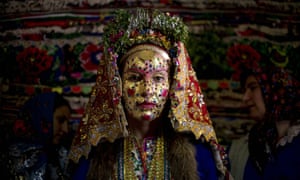
Pomak Muslims still live in Greek and Bulgarian villages. This bride is embarking on her two-day winter wedding in Ribnovo, 210 km from Sofia
Simon Kuper
25 February 2017
Border: A Journey to the Edge of EuropeKapka Kassabova
Granta, pp.379, £14.99
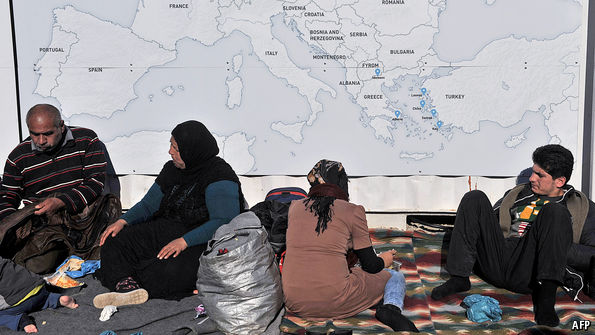
In Ali’s Café, just inside Turkey on the Bulgarian border, Iraqi and Syrian refugees spend their days drinking tea. Now and then, someone goes into the back room to give bundles of money to smugglers who have promised to get him into the European Union. Only when piano chords strike up on the radio does Kapka Kassabova realise what Ali’s reminds her of: Rick’s Bar in the movie Casablanca, a transit realm ‘where the homeless of the day come in search of passage’.
The Syrian refugees literally walked into Kassabova’s book. Like many ruined peoples before them, they were heading for the border she was writing about — the crossing point between Turkey, Bulgaria and Greece where ‘Europe’ has tried for centuries to build its wall with the East. This lazy-paced, directionless yet valuable book brings to life not just a neglected region but also one of the themes of our time: borders, open and closed.
Kassabova has the obsession with borders that comes from growing up behind the Iron Curtain. Raised in communist Bulgaria, she later emigrated to New Zealand, and now lives in Scotland. But she always yearned to see the borderlands that had been sealed to her, ‘the forbidden places of my childhood’. For this book she spent years gathering the stories of ordinary border-dwellers.
Today Turkey, Greece and Bulgaria have ‘three alphabets, three currencies, three versions of history’. But for most of history the border was blurrier. People on all sides descended from the ancient Thracians (almost forgotten now, because unlike their Greek contemporaries they didn’t leave behind any writing). Later, Muslims, Catholics and orthodox Christians were sprinkled almost randomly around the region. In the Ottoman empire, you found the unlikeliest people all over the place.
The anthropologist Ernest Gellner famously said that the ethnographic map of Europe used to look like a painting by Oskar Kokoschka, a ‘riot of diverse points of colour’. But after the multi-ethnic empires collapsed in 1918, the map came to resemble a Modigliani: neat flat surfaces clearly separated from each other.
The post-Ottoman nation states achieved this through ethnic cleansing. Kassabova describes the horrors: Greek-speakers in Turkey and Muslims and Bulgarian-speakers in Greece were wrenched from their ancestral homes and marched off to ‘homelands’ they didn’t know. They would arrive, writes Kassabova, in ‘an empty house in a foreign country with the kitchen pots still warm’. Many of these people remained ‘homesick for the rest of their lives’. Kassabova finds one family, displaced from Bulgaria just across the border into Turkey, who could look across the hills at their original village, until it was cleared by the army in 1948 and eventually swallowed by the forest.
Some displaced people transmitted their homesickness to their children, even their grandchildren. Every summer now, Thrace witnesses an ‘ancestral pilgrimage’ of people who drive across borders to visit their grandparents’ houses. They are generally welcomed by the locals, who know how it feels.
Many of the characters in this book think of themselves as still exiled. Some clearly wish themselves back in that pre-1918 Kokoschka painting: Kassabova attends an Orthodox Easter service in a Turkish border town where half the congregants are Muslims. And tiny vestiges of the original Kokoschka painting survive, such as the Pomak Muslims still living in Greek and Bulgarian villages.
The region’s Jews were scrubbed from the painting in the second world war. Afterwards, the border became the southern section of the Iron Curtain. Previously people had been forced to cross; during the Cold War, they weren’t allowed to cross. Kassabova recounts the story of a Turkish shepherd in 1970, who, watering his horse at the border river, exchanged cheery greetings with a shepherd across the way in Bulgaria. A Turkish patrol saw him do it. The shepherd was jailed for espionage and eventually hanged himself. Hundreds of people, especially Bulgarians and East Germans, were killed trying to cross this border. In 1989, the dying Bulgarian communist regime revived the periodic ritual of forcing the country’s ethnic Turks to take Slav names. About 340,000 people preferred to move to Turkey.
A closed border is a dead end, where few people want to live, and where the authorities distrust everybody. Some border-dwellers were moved during the Cold War to less sensitive regions. Others left voluntarily, abandoning their houses. The two heartland villages of the ancient Greek-Bulgarian cult of fire worship, Madjura and Pirgopulo, now each have a population of zero. In an otherwise empty Turkish village, a man and wife living alone with their sheep sigh, ‘All we need is another family.’
Kassabova finds Greek villages that were ‘decimated four times: by refugee outflows, the second world war, the civil war, and then the Cold War’. After all this, the region, always sparsely populated, has become possibly Europe’s last wilderness. Kassabova describes a viper-filled forest straight out of the Iliad, and a dying village with plum trees that very occasionally feels like Eden.
When the border reopened in the 1990s, people on all sides discovered all the things they still had in common. There is a (much too long) chapter on Bulgarian and Greek villagers getting together for a fire-walking ceremony. (Kassabova has a spiritual streak, and readers will need high tolerance for evil eyes, bean readers and mystical fireballs.)
Now the border is closing again. As the Syrians and Iraqis try to head west, Turkey’s president Recep Tayyip Erdogan has done a deal with the EU to keep them in his country. Kassabova empathises with the refugees. In 1991, during Bulgaria’s post-communist collapse, her freshly impoverished academic family sat in Sofia waiting by candlelight for emigration visas. Now, when she meets Iraqi Kurdish teenage girls stuck in a Turkish nowheresville, she feels everything with them: the humiliation, the injustice, the mindfuck of having to hate where you come from but having nothing new to love… The sensation of being invisible, unwanted, speechless, a disembodied soul waiting in one of history’s drafty corridors.
Many of today’s border peoples feel that same empathy: they see in the exhausted figures walking into exile the ghosts of their own great-grandparents.
Some of the new refugees may remain stuck in Turkey their whole lives. They will have children there, become new ethnic groups — post-2011 Syrian Turks, say. Then one day some ruler might decide to cleanse them too.
This is an occasionally fascinating but flawed book. It has no narrative drive. Though Kassabova has merged bits of her interviewees’ stories, she has scarcely imposed structure or selection. She also has an odd habit of beginning a story at the end, and then continuing to the beginning. Then there is her tendency to the high-flown:
The border forest is where destiny becomes manifest, if we linger too long. No wonder it repels and attracts like a karmic magnet. In the border forest, we condemn and absolve ourselves, again and again. There is death foretold in that, and there is immense compulsion.
Whatever.
But even when the writing isn’t great, the subject is. Most books are written by metropolitans, who tend to ignore peripheries. Reading Kassabova, you get a sense of an eternal pendulum swing between open and closed borders. The latest swing has just begun, with Brexit, Erdogan’s border wall, and soon maybe Trump’s. Almost by accident, Kassabova has written a book for our time.
Simon Kuper is a columnist for the Financial Times. His books include Football Against the Enemy and Why England Lose.
The long tragedy of Europe’s borderland | The Spectator
Border: A Journey to the Edge of Europe by Kapka Kassabova – review
This study of a conflict-strewn corner of Europe, where minorities have frequently been oppressed, is highly topical
Simon Kuper
25 February 2017
Border: A Journey to the Edge of EuropeKapka Kassabova
Granta, pp.379, £14.99
In Ali’s Café, just inside Turkey on the Bulgarian border, Iraqi and Syrian refugees spend their days drinking tea. Now and then, someone goes into the back room to give bundles of money to smugglers who have promised to get him into the European Union. Only when piano chords strike up on the radio does Kapka Kassabova realise what Ali’s reminds her of: Rick’s Bar in the movie Casablanca, a transit realm ‘where the homeless of the day come in search of passage’.
The Syrian refugees literally walked into Kassabova’s book. Like many ruined peoples before them, they were heading for the border she was writing about — the crossing point between Turkey, Bulgaria and Greece where ‘Europe’ has tried for centuries to build its wall with the East. This lazy-paced, directionless yet valuable book brings to life not just a neglected region but also one of the themes of our time: borders, open and closed.
Kassabova has the obsession with borders that comes from growing up behind the Iron Curtain. Raised in communist Bulgaria, she later emigrated to New Zealand, and now lives in Scotland. But she always yearned to see the borderlands that had been sealed to her, ‘the forbidden places of my childhood’. For this book she spent years gathering the stories of ordinary border-dwellers.
Today Turkey, Greece and Bulgaria have ‘three alphabets, three currencies, three versions of history’. But for most of history the border was blurrier. People on all sides descended from the ancient Thracians (almost forgotten now, because unlike their Greek contemporaries they didn’t leave behind any writing). Later, Muslims, Catholics and orthodox Christians were sprinkled almost randomly around the region. In the Ottoman empire, you found the unlikeliest people all over the place.
The anthropologist Ernest Gellner famously said that the ethnographic map of Europe used to look like a painting by Oskar Kokoschka, a ‘riot of diverse points of colour’. But after the multi-ethnic empires collapsed in 1918, the map came to resemble a Modigliani: neat flat surfaces clearly separated from each other.
The post-Ottoman nation states achieved this through ethnic cleansing. Kassabova describes the horrors: Greek-speakers in Turkey and Muslims and Bulgarian-speakers in Greece were wrenched from their ancestral homes and marched off to ‘homelands’ they didn’t know. They would arrive, writes Kassabova, in ‘an empty house in a foreign country with the kitchen pots still warm’. Many of these people remained ‘homesick for the rest of their lives’. Kassabova finds one family, displaced from Bulgaria just across the border into Turkey, who could look across the hills at their original village, until it was cleared by the army in 1948 and eventually swallowed by the forest.
Some displaced people transmitted their homesickness to their children, even their grandchildren. Every summer now, Thrace witnesses an ‘ancestral pilgrimage’ of people who drive across borders to visit their grandparents’ houses. They are generally welcomed by the locals, who know how it feels.
Many of the characters in this book think of themselves as still exiled. Some clearly wish themselves back in that pre-1918 Kokoschka painting: Kassabova attends an Orthodox Easter service in a Turkish border town where half the congregants are Muslims. And tiny vestiges of the original Kokoschka painting survive, such as the Pomak Muslims still living in Greek and Bulgarian villages.
The region’s Jews were scrubbed from the painting in the second world war. Afterwards, the border became the southern section of the Iron Curtain. Previously people had been forced to cross; during the Cold War, they weren’t allowed to cross. Kassabova recounts the story of a Turkish shepherd in 1970, who, watering his horse at the border river, exchanged cheery greetings with a shepherd across the way in Bulgaria. A Turkish patrol saw him do it. The shepherd was jailed for espionage and eventually hanged himself. Hundreds of people, especially Bulgarians and East Germans, were killed trying to cross this border. In 1989, the dying Bulgarian communist regime revived the periodic ritual of forcing the country’s ethnic Turks to take Slav names. About 340,000 people preferred to move to Turkey.
A closed border is a dead end, where few people want to live, and where the authorities distrust everybody. Some border-dwellers were moved during the Cold War to less sensitive regions. Others left voluntarily, abandoning their houses. The two heartland villages of the ancient Greek-Bulgarian cult of fire worship, Madjura and Pirgopulo, now each have a population of zero. In an otherwise empty Turkish village, a man and wife living alone with their sheep sigh, ‘All we need is another family.’
Kassabova finds Greek villages that were ‘decimated four times: by refugee outflows, the second world war, the civil war, and then the Cold War’. After all this, the region, always sparsely populated, has become possibly Europe’s last wilderness. Kassabova describes a viper-filled forest straight out of the Iliad, and a dying village with plum trees that very occasionally feels like Eden.
When the border reopened in the 1990s, people on all sides discovered all the things they still had in common. There is a (much too long) chapter on Bulgarian and Greek villagers getting together for a fire-walking ceremony. (Kassabova has a spiritual streak, and readers will need high tolerance for evil eyes, bean readers and mystical fireballs.)
Now the border is closing again. As the Syrians and Iraqis try to head west, Turkey’s president Recep Tayyip Erdogan has done a deal with the EU to keep them in his country. Kassabova empathises with the refugees. In 1991, during Bulgaria’s post-communist collapse, her freshly impoverished academic family sat in Sofia waiting by candlelight for emigration visas. Now, when she meets Iraqi Kurdish teenage girls stuck in a Turkish nowheresville, she feels everything with them: the humiliation, the injustice, the mindfuck of having to hate where you come from but having nothing new to love… The sensation of being invisible, unwanted, speechless, a disembodied soul waiting in one of history’s drafty corridors.
Many of today’s border peoples feel that same empathy: they see in the exhausted figures walking into exile the ghosts of their own great-grandparents.
Some of the new refugees may remain stuck in Turkey their whole lives. They will have children there, become new ethnic groups — post-2011 Syrian Turks, say. Then one day some ruler might decide to cleanse them too.
This is an occasionally fascinating but flawed book. It has no narrative drive. Though Kassabova has merged bits of her interviewees’ stories, she has scarcely imposed structure or selection. She also has an odd habit of beginning a story at the end, and then continuing to the beginning. Then there is her tendency to the high-flown:
The border forest is where destiny becomes manifest, if we linger too long. No wonder it repels and attracts like a karmic magnet. In the border forest, we condemn and absolve ourselves, again and again. There is death foretold in that, and there is immense compulsion.
Whatever.
But even when the writing isn’t great, the subject is. Most books are written by metropolitans, who tend to ignore peripheries. Reading Kassabova, you get a sense of an eternal pendulum swing between open and closed borders. The latest swing has just begun, with Brexit, Erdogan’s border wall, and soon maybe Trump’s. Almost by accident, Kassabova has written a book for our time.
Simon Kuper is a columnist for the Financial Times. His books include Football Against the Enemy and Why England Lose.
The long tragedy of Europe’s borderland | The Spectator
Border: A Journey to the Edge of Europe by Kapka Kassabova – review
This study of a conflict-strewn corner of Europe, where minorities have frequently been oppressed, is highly topical
A Bulgarian Pomak bride: one of the groups treated with suspicion in the communist era. Photograph: Nikolay Doychinov/AFP/Getty Images
Sara Wheeler
Sunday 5 February 2017
This is a book about that shadowy region where Bulgaria, Greece and Turkey converge and diverge. During “half a century of cold war hardness”, writes Kapka Kassabova in this thoughtful and impressive volume, the zone was “a forested Berlin Wall darkened by the armies of three countries”. She says it remains “prickly with dread”.
Born in 1973 under Pontic skies, Kassabova, whose previous books include Street Without a Name: Childhood and Other Misadventures in Bulgaria, now lives in Scotland. `In Border, she arranges her material broadly geographically, starting and ending on the Black Sea at the edge of the Strandja ranges where Mediterranean and Balkan currents meet. She mixes memoir with travelogue, journeying mostly in an old Renault, directed by “freakish serendipities” and with topographical description, literary references, reflection on what the concept of “border” means, and above all, long quotations from people she encounters on her travels, oral history style.
For her composite picture, Kassabova draws artfully on Slavic folklore, ancient customs such as fire walking, myths involving Uzbek-bred vipers and snippets of history, though she never falls into the trap of rehashing the whole damn political tragedy. She also focuses on key words exemplifying her themes, such as memleket (homeland) from the Turkish meme (breast).
Border: A Journey to the Edge of Europe by Kapka Kassabova – review | Books | The Guardian
A writer explores Europe’s south-eastern border
Sara Wheeler
Sunday 5 February 2017
This is a book about that shadowy region where Bulgaria, Greece and Turkey converge and diverge. During “half a century of cold war hardness”, writes Kapka Kassabova in this thoughtful and impressive volume, the zone was “a forested Berlin Wall darkened by the armies of three countries”. She says it remains “prickly with dread”.
Born in 1973 under Pontic skies, Kassabova, whose previous books include Street Without a Name: Childhood and Other Misadventures in Bulgaria, now lives in Scotland. `In Border, she arranges her material broadly geographically, starting and ending on the Black Sea at the edge of the Strandja ranges where Mediterranean and Balkan currents meet. She mixes memoir with travelogue, journeying mostly in an old Renault, directed by “freakish serendipities” and with topographical description, literary references, reflection on what the concept of “border” means, and above all, long quotations from people she encounters on her travels, oral history style.
For her composite picture, Kassabova draws artfully on Slavic folklore, ancient customs such as fire walking, myths involving Uzbek-bred vipers and snippets of history, though she never falls into the trap of rehashing the whole damn political tragedy. She also focuses on key words exemplifying her themes, such as memleket (homeland) from the Turkish meme (breast).
Border: A Journey to the Edge of Europe by Kapka Kassabova – review | Books | The Guardian
A writer explores Europe’s south-eastern border
Mapping history
A walk through the continent’s mountainous south-eastern corner
A walk through the continent’s mountainous south-eastern corner
Print edition | Books and artsFeb 11th 2017
Border: A Journey to the Edge of Europe. By Kapka Kassabova. Granta; 379 pages; £14.99. To be published in America by Graywolf in September; $16.
TRAGEDIES and mistakes are strewn across Europe’s borderlands. Nowhere more so than in the continent’s mountainous south-eastern corner, where the Iron Curtain once divided communist Bulgaria from capitalist Greece and Turkey. The land is haunted by that divide, and by vanished kingdoms, peoples and wars. Kapka Kassabova’s poignant, erudite and witty third book, “Border”, brings hidden history vividly to light.
The central theme of the book, topically, is frontiers. Lines on the map that are drawn and policed by the powerful, protect one sort of interests while severing others. “An actively policed border is always aggressive,” she writes. “It is where power acquires a body, if not a human face, and an ideology.”
Some of the book’s most striking passages are about “well-oiled feudal barbarity”, the abominable treatment that was meted out to those who tried to escape: tricked and betrayed, beaten and jailed, or shot in cold blood and left to bleed to death. At a time when memories of the Soviet empire’s vast prison camp are fading, the story Ms Kassabova has to tell is important. She grew up in communist Bulgaria and remembers that system’s arbitrary cruelty, which finds echoes today in the mistreatment of refugees and migrants.
The post-communist era brought new problems: corruption, petty nationalist quarrels and environmental ruin. Ms Kassabova’s book drips with scorn for the spivs, goons and far-off politicians whose greed and carelessness wreak such mischief and misery. She was inspired to write it after witnessing the “roughshod levelling” of her adopted home in the Scottish Highlands, and later, when helping Bulgarians clean up after a flood caused by illegal logging and the looting of sand, she shouts, “Something must be done.” “It’s because you don’t live here…You still believe in justice,” comes the crushing retort.
A particular treat is her ear for lurid local myths. Extraterrestrial beacons, mysterious balls of fire, lost pyramids and a secret site guarded by specially bred Uzbek vipers all get a look in. The first account of the region was in the fifth century BC, by Herodotus. Ms Kassabova gamely takes up the first historian’s torch. Her writing also has echoes of Patrick Leigh Fermor’s epic tramp across the pre-war Balkans. But her sparse, ironic style lacks the self-conscious self-indulgence of Fermor’s prose, and is all the better for it.
She treads lightly but distinctly through the stories she tells, displaying an enviable mixture of rapport with her subjects and detachment from their peculiarities. Leaving her favourite valley in the Strandja mountains was “like pulling myself out with a corkscrew”, she writes. She highlights stories barely known outside the region, such as the communist Bulgarian regime’s vindictive deportation of 340,000 ethnic Turks in the 1980s and the doomed 15-year struggle of the Goryani (Woodlanders) against communist rule. Their fate is absent from Bulgaria’s modern history: their mouths, she writes, “are full of earth”.
Yet the author’s astringent approach to myths and falsehoods could be more evenly applied. Many might quibble with Ms Kassabova’s unsupported assertion that the Goryani were the “largest, longest-sustained resistance movement against Soviet state terror in eastern Europe” (Ukraine’s and Poland’s anti-communist guerrilla movements were the biggest, and the last Estonian partisan was on the run until 1978). The story of an East German family fleeing to the West in a home-made balloon is not, as she dismisses it, “apocryphal”: the briefest research reveals that it really happened, in 1979. Britain’s foreign espionage service is MI6, not MI5.
But these flaws pale against the strength of the book: its treatment of history’s blessings and curses. Past imperial ages—chiefly Byzantine and Ottoman—laid down complex, and mostly harmonious, layers of languages, ethnicities, cultures and religions, erased in the name of nation-building and tidiness. Communities with roots going back centuries were pulled up and dumped across borders that had once hardly mattered, into countries that they scarcely knew. It is a “melancholy miracle”, writes Ms Kassabova, that “odd ragged bits of this once-rich human tapestry” survive. They could have no better chronicler.
A writer explores Europe’s south-eastern border: Mapping history | The Economist
.
.
.


