Jay Doubleyou: the idea of progress for the esl classroom
Jay Doubleyou: the men who made us spend: part three
Jay Doubleyou: the story of stuff
The industry is fighting back:
Videos | Minerals Education Coalition
UNITED STATES:

Mineral Usage Statistics | Minerals Education Coalition

Mining Videos - Modern.
.
Mining Matters in your Everyday Life - YouTube
.
Phosphate Mining In Florida - YouTube
The disconnect on the importance of mining - YouTube
BUT:
Where Have All the Mountains Gone?
In this week before I Love Mountains Day (an annual day of lobbying, rallying, and marching in Frankfort), it is more important than ever to be conscious of where our energy comes from and what we can do to protect our mountains and

our people from the atrocities of mountaintop removal mining. This practice of accessing coal from the mountains of the Appalachian region consists of literally blowing off the top of the mountain with explosives to get to the thin layer of coal underneath. The environmental effects of this practice are fairly apparent. Mountaintop removal mining has affected over 400,000 acres of land in Kentucky, Tennessee, Virginia, and West Virginia combined, including over 1,200 miles of streambeds. In the state of Kentucky alone, over 724 miles of streams have been destroyed and more than 150 square miles of mountains are now flat due to this process. Even though coal companies are technically required to restore the destroyed land area to its former quality through the process of reclamation, this process rarely repairs much damage at all—if any. Currently, reclamation practices simply convert these ancient forests into grasslands; the original level of biodiversity and life could not possibly be restored for thousands of years. In mining permit applications, coal companies are required to specifically describe what the land will be used for post-mining (e.g. recreational use, commercial use, agricultural use, etc.); however, many permits are approved without such details.
More time efficient than underground mining, mountaintop removal requires significantly fewer “miners” and is considerably cheaper for the coal companies carrying out such projects. While coal production
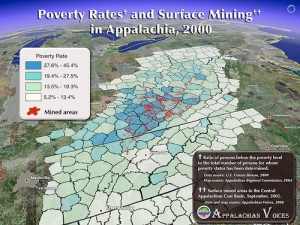 rose in the decade between 1987 and 1997 by more than 30%, the number of workers employed in mining occupations actually dropped by 29%. Hence, despite arguments from locals that protesters of this form of mining are taking jobs away from the region, mountaintop removal mining in itself takes jobs away from Appalachians, causing damage to the local economy. Furthermore, although it may make sense for a region rich in coal to reap the financial benefits of such richness, the fact of the matter is that all of such assets are given over to the coal companies, leaving the region containing the mineral-saturated land impoverished. For instance, in the state of West Virginia, the top fifteen coal-producing counties are some of the poorest in the entire nation—despite producing 15% of coal in the U.S. One only needs to take a quick glance at poverty rates in counties where mountaintop removal is prevalent to notice that something is not quite right. As of the year 2000, the majority of counties of Kentucky, Tennessee, Virginia, and West Virginia that contained mountaintop removal sites had poverty rates of over 20%; an entire fifth of these counties’ populations were living under the poverty line.
Where Have All the Mountains Gone? | HEAL
iLoveMountains.org — Learn more about mountaintop removal coal mining -- End Mountaintop Removal Coal Mining
Plundering Appalachia - The Tragedy of Mountaintop-Removal Coal Mining :: The Issue
Destroying Mountains | Beyond Coal
Mining the Mountains | EcoCenter: Energy | Smithsonian
Apple's icloud is Blowing up Appalachian Mountains - Green Pages News 08.05.12 with Katie Patrick from Katie Patrick on Vimeo.
AUSTRALIA:
Anti-carbon tax campaign ramped up - YouTube
AMEC Mining Tax Ad - YouTube

STW Group | Minerals Council of of Australia 'Keep Mining Strong'

The mining-tax scare website is an excellent case study | Alex White
New campaign highlights good side of mining | Mining Australia
BUT:
Under cover of racist myth, a new land grab in Australia
Claims of child abuse are proving a fertile pretext to menace the Aboriginal communities lying in the way of uranium mining

John Pilger The Guardian, Friday 24 October 2008
Jump to comments (218)
Its banks secured in the warmth of the southern spring, Australia is not news. It ought to be. An epic scandal of racism, injustice and brutality is being covered up in the manner of apartheid South Africa. Many Australians conspire in this silence, wishing never to reflect upon the truth about their society's Untermenschen, the Aboriginal people.
The facts are not in dispute: thousands of black Australians never reach the age of 40; an entirely preventable disease, trachoma, blinds black children as epidemics of rheumatic fever ravage their communities; suicide among the despairing young is common. No other developed country has such a record. A pervasive white myth, that Aborigines leech off the state, serves to conceal the disgrace that money the federal government says it spends on indigenous affairs actually goes towards opposing native land rights. In 2006, some A$3bn was underspent "or the result of creative accounting", reported the Sydney Morning Herald. Like the children of apartheid, the Aboriginal children of Thamarrurr in the Northern Territory receive less than half the educational resources allotted to white children.
In 2005, the UN committee on the elimination of racial discrimination described the racism of the Australian state, a distinction afforded no other developed country. This was in the decade-long rule of the conservative coalition of John Howard, whose coterie of white supremacist academics and journalists assaulted the truth of recorded genocide in Australia, especially the horrific separations of Aboriginal children from their families. They deployed arguments not dissimilar to those David Irving used to promote Holocaust denial.
Smear by media as a precursor to the latest round of repression is long familiar to black Australians. In 2006, the flagship current affairs programme of the Australian Broadcasting Corporation, Lateline, broadcast lurid allegations of "sex slavery" among the Mutitjulu people in the Northern Territory. The programme's source, described as an "anonymous youth worker", was later exposed as a federal government official whose "evidence" was discredited by the Northern Territory chief minister and the police.
The ABC has never retracted its allegations, claiming it has been "exonerated by an internal inquiry". Shortly before last year's election, Howard declared a "national emergency" and sent the army to the Northern Territory to "protect the children" who, said his minister for indigenous affairs, were being abused in "unthinkable numbers".
Last February, with much sentimental fanfare, the new prime minister, Labor's Kevin Rudd, made a formal apology to the first Australians. Australia was said to be finally coming to terms with its rapacious past and present. Was it? "The Rudd government," noted a Sydney Morning Herald editorial, "has moved quickly to clear away this piece of political wreckage in a way that responds to some of its own supporters' emotional needs, yet it changes nothing. It is a shrewd manoeuvre."
In May, barely reported government statistics revealed that of the 7,433 Aboriginal children examined by doctors as part of the "national emergency", 39 had been referred to the authorities for suspected abuse. Of those, a maximum of just four possible cases of abuse were identified. Such were the "unthinkable numbers". They were little different from those of child abuse in white Australia. What was different was that no soldiers invaded the beachside suburbs, no white parents were swept aside, no white welfare was "quarantined". Marion Scrymgour, an Aboriginal minister in the Northern Territory, said: "To see decent, caring [Aboriginal] fathers, uncles, brothers and grandfathers, who are undoubtedly innocent of the horrific charges being bandied about, reduced to helplessness and tears, speaks to me of widespread social damage."
What the doctors found they already knew - children at risk from a spectrum of extreme poverty and the denial of resources in one of the world's richest countries. Having let a few crumbs fall, Rudd is picking up where Howard left off. His indigenous affairs minister, Jenny Macklin, has threatened to withdraw government support from remote communities that are "economically unviable". The Northern Territory is the only region where Aborigines have comprehensive land rights, granted almost by accident 30 years ago. Here lie some of the world's biggest uranium deposits. Canberra wants to mine and sell it.
Foreign governments, especially the US, want the Northern Territory as a toxic dump. The Adelaide to Darwin railway that runs adjacent to Olympic Dam, the world's largest uranium mine, was built with the help of Kellogg, Brown & Root - a subsidiary of American giant Halliburton, the alma mater of Dick Cheney, Howard's "mate". "The land grab of Aboriginal tribal land has nothing to do with child sexual abuse," says the Australian scientist Helen Caldicott, "but all to do with open slather uranium mining and converting the Northern Territory to a global nuclear dump."
What is unique about Australia is not its sun-baked, derivative society, clinging to the sea, but its first people, the oldest on earth, whose skill and courage in surviving invasion, of which the current onslaught is merely the latest, deserve humanity's support.
John Pilger: Under cover of racist myth, a new land grab in Australia | Comment is free | The Guardian
Breaking the great Australian silence
The mining industry today makes profits of a billion dollars a week on Indigenous land.
In the lucky country of Australia apartheid is alive and kicking | John Pilger | Comment is free | The Guardian
Utopia - A film by John Pilger - Official trailer - YouTube
John Pilger's Utopia: watch the world exclusive trailer - video | Film | The Guardian
Utopia (2013 film) - Wikipedia, the free encyclopedia
Home | UTOPIA
BRITAIN:
UK companies offer full range of services to mining industry - News articles - GOV.UK
BUT:
.
The Coal War - Panorama - YouTube
Why did margaret thatcher close the coal mines in England and wales, when she was the prime minister?
John Prescott: Margaret Thatcher closed the mines out of sheer political spite - John Prescott - Mirror Online
BBC News - Cabinet papers reveal 'secret coal pits closure plan'
Margaret Thatcher wanted to crush the miners. That's all she wanted | Politics | theguardian.com
Wilson closed more coal mines than Thatcher | Conservative Home
Ten myths about Margaret Thatcher exploded – Telegraph Blogs
.
.
.
Breaking the great Australian silence
The mining industry today makes profits of a billion dollars a week on Indigenous land.
In the lucky country of Australia apartheid is alive and kicking | John Pilger | Comment is free | The Guardian
Utopia - A film by John Pilger - Official trailer - YouTube
John Pilger's Utopia: watch the world exclusive trailer - video | Film | The Guardian
Utopia (2013 film) - Wikipedia, the free encyclopedia
Home | UTOPIA
BRITAIN:
News article
UK companies offer full range of services to mining industry
Countries wishing to develop their own mining capabilities should look to the UK’s world-leading strengths in innovative solutions, education and training provision.
From:
First published:
11 October 2013
Part of:
From:
UK companies are internationally renowned for delivering expertise across the entire span of the global mining sector.
Thanks to Britain’s world-famous mining heritage — forged in the heat of the Industrial Revolution — the UK has a long-established reputation for first-class engineering, construction and infrastructure capabilities. And, today, London is known as a global centre of mining finance, underpinned by recognised regulatory and legal frameworks, which provides liquidity to international projects of every size. In 2012, UK-listed mining companies had a total market capitalisation of $425bn — more than any other financial market in the world.
Yet mining is a complex, wide-ranging and high value opportunity industry with diverse needs — one that uses British innovation to deliver solutions across every part of the sector, from financing through to maintenance services.
This includes feasibility and development studies; legal, advisory, accountancy, tax and audit services; risk management, project management, best practice, environmental, logistics, legacy management and closure-planning services and communications strategies.
For example, a global team from UK-based professional services firmDeloitte provided strategical and tactical support to Rio Tinto’s Simandou Project and integrated infrastructure operations in Guinea. This included end business operating model design, programme planning, study coordination, contracting strategy, regional economic development and contracting management advice — as well as integrated communications to joint venture partners.
It is this ability to deliver cross-sector skills and services which has put UK firms at the forefront of the global mining industry.
UK companies offer full range of services to mining industry - News articles - GOV.UK
BUT:
.
The Coal War - Panorama - YouTube
Why did margaret thatcher close the coal mines in England and wales, when she was the prime minister?
John Prescott: Margaret Thatcher closed the mines out of sheer political spite - John Prescott - Mirror Online
BBC News - Cabinet papers reveal 'secret coal pits closure plan'
Margaret Thatcher wanted to crush the miners. That's all she wanted | Politics | theguardian.com
Wilson closed more coal mines than Thatcher | Conservative Home
Ten myths about Margaret Thatcher exploded – Telegraph Blogs
.
.
.