Sunday, 8 September 2013

what are you good at?

The fourth (and last for the moment) of a series from: Jay Doubleyou: this column will change your life:

This column will change your life: why do we undervalue what we're good at?

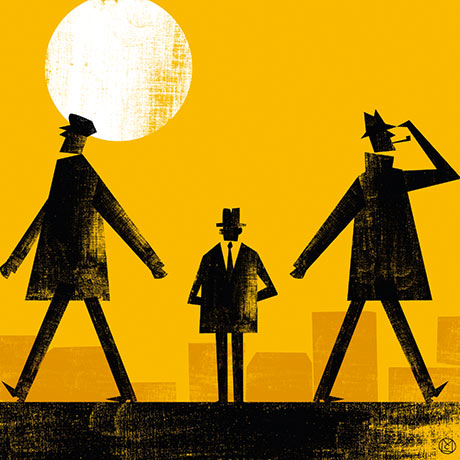
'If a talent comes naturally, you conclude that it's nothing special. And so you gravitate toward whatever it is you can't do'
Oliver Burkeman illustrationView larger picture
Illustration: Chris Madden for the Guardian. Click on image for full picture.
I don't have much patience, generally speaking, with the ideas of economists like Murray Rothbard, a free-market extremist who thought the government shouldn't run the police or the army, let alone hospitals or schools. Still, we owe him gratitude for the tongue-in-cheek observation he called Rothbard's Law: "People tend to specialise in what they're worst at."
Other examples may spring to your mind: the comedian intent on being taken seriously as an actor; the religious figure who can't stop making pronouncements about science; the manager with zero people skills who nominates himself to run the corporate retreat. 
At first glance, Rothbard's Law resembles the similarly half-serious Peter Principle, which describes how, in organisations, people tend to rise to their "level of incompetence". They keep getting promoted until they're in a role where their performance is too mediocre to merit further promotion – so that, over time, a company gets filled with staff who can't do their jobs. (See below)
But Rothbard seems to have had a different problem in mind: if a talent has always come naturally – or if it's been decades since you last found it difficult – you conclude that it's nothing special. And so, in your efforts to achieve something impressive, or to gain a feeling of accomplishment, you gravitate toward whatever it is you can't do. You stride out into exactly those fresh pastures in which you shouldn't be setting foot.
Rothbard was exaggerating for the sake of humour. Yet his insight adds an interesting twist to the time-honoured debate about strengths and weaknesses. If you want to improve, should you focus on developing what you're good at, or on patching things up where you're bad? In a series of bestselling books, the consultant Marcus Buckingham has made a persuasive case for a strengths-based approach: it's both more effective and more enjoyable, he argues, than struggling to plug your weak spots. (Follow the links)
But Rothbard's Law raises two complicating thoughts. One is that you might not perceive your strengths at all, imagining them instead to be run-of-the-mill capabilities possessed by everyone.
 The other is that focusing on them might feel boring, even meaningless, compared with the thrill of the unknown.
The trick – easier to talk about than to do, as ever – is to pick challenges adjacent to your existing skills, not diametrically opposed to them. The more profound difficulty is to learn to see your unique skills for what they are – and, when it comes to salary negotiations and suchlike, to resist undervaluing them.
 All this might sound like the cheesiest sort of self-esteem-boosting advice: "Everyone's good at something!" I'm sure that mushy conclusion would have appalled Rothbard. The more down-to-earth, more genuinely cheering implication of his law is that you may well be more talented than you think.


the Peter Principle noun - definition in the Business English Dictionary - Cambridge Dictionaries Online
.
.
.

what's it costing you to sleep?

The third of a series from: Jay Doubleyou: this column will change your life:

This column will change your life: you snooze, you lose

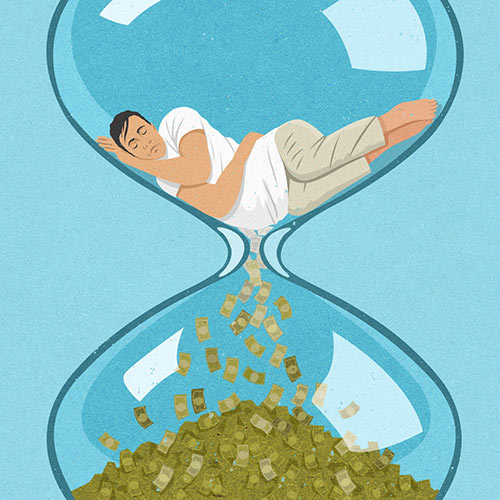
'The Money Shredding Alarm Clock is the perfect metaphor for capitalism'
Oliver Burkeman illustrationView larger picture
Illustration: John Holcroft for the Guardian. Click on image for full picture
The Money Shredding Alarm Clock – details of which surfaced online a few weeks ago – surely signifies the end of the long-running quest to design the most effective way of waking up. (Do have a look!)
More evil than Clocky, the alarm clock that rolls away when you reach out to silence it, (wow!!)
or the Puzzle Alarm, which makes you complete a simple puzzle before it'll go quiet, the Money Shredding Alarm Clock methodically destroys your cash unless you rouse yourself. 
PUZZLE ALARM CLOCK
It isn't mentioned in Jonathan Crary's fascinating new book 24/7: Late Capitalism And The Ends Of Sleep, but I suspect he'd regard it with both horror and a sense of vindication, since it's the perfect metaphor for his argument. In a consumer society, the official point of life is to make money, then use it to buy things. Lazing in bed sets you back in this interminable rat race. The Money Shredding Alarm Clock simply makes all that more literal: you snooze, you lose. (See links/reviews below)
Crary's (broadly Marxist) thesis is that sleep is one of the last remaining spaces of resistance to capitalism's unremitting march. The world is becoming "a non-stop work site or an always-open shopping mall of infinite choice", yet you can't work or shop when you're sleeping. "The huge portion of our lives that we spend asleep, freed from a morass of simulated needs, [remains] one of the great human affronts to the voraciousness of contemporary capitalism," he writes. In an increasingly individualised world, sleep is also oddly communal: every time you drift off, you're entrusting yourself to your society – if only by your faith that no one will murder you in your sleep. (Sorry about the heavy politics, but...)
It's hardly surprising, from this perspective, that sleep is under attack.One in three British workers is chronically sleep-deprived, we're told; celebrity business leaders like to boast about rising early, while those lower down the ladder, saddled with shiftwork and lengthy commutes, have no choice but to sleep fewer hours. (Click on the links)
The American military is leading research into drugs, dietary changes and hi-tech breathing masks that might greatly reduce the need for sleep, while smartphones and iPads take over our bedrooms, their glowing screens disrupting our rest. Tech culture is even helping cheapen the very concept of sleep, Crary notes: "sleep mode" on your laptop just means it's waiting until it can be productive again.
The 24/7 world obliterates rhythms – days and nights, work and play, the seasons. Sleep is the only guaranteed daily change of pace. Even the idea of a single sleep every 24 hours is a concession to industralisation: left to their own devices, some research suggests, people revert to sleeping in two portions, with a few hours' quiet wakefulness in between, reminiscent of the "first sleep" and "second sleep" common in medieval England.
At this point, though, if you're familiar with the world of productivity blogs and business self-help books, an objection might occur. These days, their authors seem obsessed with the importance of getting enough sleep. But does this really undermine Crary's case? Arguably, it's just one more way for capitalism to colonise sleep: not by eroding it, but by redefining it as mere preparation for more work. Productivity advice increasingly has this nurturing feel: get enough rest! Spend more time in nature! Take a digital detox! But it's still productivity advice, and so there are pressing questions to be asked. Sure, it helps you get more done, but is it the stuff you want to be getting done? And whose interests are you serving by doing it?


24/7: Late Capitalism and the Ends of Sleep: Jonathan Crary: 9781781680933: Amazon.com: Books
24/7: Terminal Capitalism and the Ends of Sleep: Amazon.co.uk: Jonathan Crary: Books
24/7: Late Capitalism and the Ends of Sleep by Jonathan Crary - Reviews, Discussion, Bookclubs, Lists

And for something a little more accessible:
Sleep - Simple English Wikipedia, the free encyclopedia
.
.
.

how do you make decisions?

The second of a series from: Jay Doubleyou: this column will change your life:

This column will change your life: decisions, decisions

'Don't take refuge in neutrality; trying to stay neutral is fraught with trouble'
This column will change your life: neutralityView larger picture
'Not deciding is also a decision.' Illustration: Mikel Casal for the Guardian
Barack Obama, we learned recently, plans to start his own "nudge unit". (See below)
This news triggered a familiar back-and-forth about whether it's OK for politicians to prod us in the direction of healthier living. But increasingly it's a debate that nudges me into irritation, because it's based on a misunderstanding. Anti-nudgers bemoan what they see as the nanny state; they think government should stay neutral on things such as diet and exercise. The problem is that staying neutral is trickier than it sounds. All else being equal, a government that decides not to influence fizzy-drink consumption (or whatever) isn't staying neutral, leaving consumers free of pressure. It's making an active choice to let the soft drink industry's persuasive efforts – ads, sponsorship – go unopposed. You might feel the anti-nudgers are in the right here: after all, governments get to enforce their wishes using the law and police, so we should be hyper-wary when they stick their noses in. What you're not entitled to claim, though, is that being anti-nudge is "staying neutral". You have to pick a side. You don't have the option of rising above the fray.
This same mistake – imagining you can take refuge in neutrality, when you can't – crops up throughout politics and our personal lives. Another high-profile example is same-sex marriage. Supporters often say government should stay neutral on who marries whom. But as the political philosopher Michael Sandel points out, that's an argument for eliminating marriage as a legal concept altogether. (See below)
When you support same-sex marriage – as you should! – you're saying the state should actively endorse gay and straight unions: nothing neutral about it. A similar error is to try to stay neutral on whether to leave a relationship (or city, or job). What you're choosing, at least for now, is to remain in it. Life doesn't offer the possibility of being neither single nor not single.
Or, to quote one of the less obnoxious self-help cliches: not deciding is also a decision. That's a subtle point, distorted by go-getting motivational types, who think it means you should never hold back. Actually, sometimes you should: "Many, if not most, of life's crises do not require immediate action," writes one cognitive therapist, Sandy Andrews. "They may, at some point, require a decision. But right now? Not usually. [So] decide not to decide... Concentrate on self-soothing. Take care of yourself until you are in a position where you can carefully assess the available information." But this entails making a conscious choice: opting for delay because the pros of doing so outweigh the cons. The pitfalls come when you believe you don't have to make any choice at all – and thereby make one anyway.
Even consciously deciding not to decide is something to do sparingly; keeping your options open isn't as rewarding as it seems. Reversible decisions lead to less happiness than irreversible ones. (See below)
In one study, subjects allowed to choose an art poster to keep reported less satisfaction with it when given the option of swapping it later for another. Fail to close doors and you'll keep fretting over your choice. It's the same old story: by not committing, you're committing… to more self-doubt and worry. Trying to stay neutral is fraught with trouble. See also: the history of Switzerland.


What is 'nudge'?
nudge verb - definition in the British English Dictionary & Thesaurus - Cambridge Dictionaries Online
Nudge (book) - Wikipedia, the free encyclopedia
Nudge: Improving Decisions About Health, Wealth, and Happiness: Richard H. Thaler, Cass R. Sunstein: 9780143115267: Amazon.com: Books

Can you follow Prof Sandel of Harvard?
Episode 12 - Justice with Michael Sandel
Justice: What's The Right Thing To Do? Episode 12: "DEBATING SAME-SEX MARRIAGE" - YouTube

Reversible decisions lead to less happiness than irreversible ones:


Why Keeping Your Options Open Is Really, Really Bad Idea

Given the choice, would you prefer to make an iron-clad, no-turning-back decision, or one you could back out of if you needed to?   Does that seem like a stupid question?  I understand why it might, but bear with me – because it isn’t.
People overwhelmingly prefer reversible decisions to irreversible ones.  They believe it’s better to “keep your options open,” whenever possible.  They wait years before declaring a major, date someone for years before getting married, favor stores with a guaranteed return policy (think Zappos), and hire employees on a temporary basis (or use probationary periods), all in order to avoid commitments that can be difficult, or nearly impossible, to un-do.
.
.
.

how useful is your job?

The first of a series from: Jay Doubleyou: this column will change your life:

This column will change your life: how to tell whether you have a bullshit job

'Is the job you're doing, or applying for, one the world would be fine without? As life strategies go, this seems a decent one'
This column will change your life: bullshit job
View larger picture

'It's hard to deny that plenty of jobs involve some bullshit.' Illustration: Adam Howling for the Guardian
It has often been observed that the future didn't turn out as predicted. By now, thanks to technology's advance, we were supposed to be working 15-hour weeks, spending the rest of our time on great literature, conversation, and leisurely jetpack trips to the dome-covered shopping mall, to check out the latest range of 1950s horn-rimmed spectacles. Instead, we're busier than ever. But it's worse than that, according to David Graeber, the anthropology professor credited with helping to launch the Occupy movement: much of that busyness is completely pointless. Entire professions, he argued in a recent essay in Strike magazine, consist of "bullshit jobs" that the world just doesn't need. If nurses and rubbish collectors disappeared overnight, we'd be in trouble; but "it's not entirely clear how humanity would suffer were all private equity CEOs, lobbyists, PR researchers, actuaries, telemarketers, bailiffs or legal consultants to similarly vanish". What explains this proliferation of pointlessness? Graeber concludes, true to his anarchist beliefs, that it's all about social control. A population kept busy with bullshit has no time to start a revolution.
Who's Graeber to say what jobs are "needed" anyway? Some would say anarchist anthropologists aren't exactly essential. Anticipating this response, he poses a different question: what about people who consider their own jobs meaningless? "I'm not sure I've ever met a corporate lawyer who didn't think their job was bullshit," he writes. "There is a profound psychological violence here. How can one even begin to speak of dignity in labour when one secretly feels one's job should not exist?"
Whether or not you agree with Graeber about the prevalence of bullshit jobs, it's hard to deny that plenty of jobs involve some bullshit. One reason we rarely complain about that, I suspect, is that we're chronically prone to confusing the feeling of putting in effort with actually getting useful things done. 
That's why lifts have "placebo buttons", which make us feel like we're achieving something when we're not. It's also why an exhausting day at the office leaves you feeling virtuous – a "hard worker" – even if you only did busywork. Two good hours on the important things, followed by an afternoon of TV and eating Monster Munch, might have been more constructive. But you'd feel like a skiver, and possibly get fired.
You can easily go too far with all this talk of meaningfulness: that way lies acres of self-help nonsense about Finding Your Life Purpose and "doing great work". But Graeber's analysis suggests a more down-to-earth question for navigating the world of careers: is the job you're doing, or applying for, one that the world would be perfectly fine without? As life strategies go, this seems a decent one: where possible, move in the direction of non-pointless activities, and away from those that reek of bullshit. Do stuff that people would miss – however slightly – if it never got done at all.


Is this an 'expletive'?
bullshit exclamationnoun - definition in the British English Dictionary & Thesaurus - Cambridge Dictionaries Online
Bullshit - Wikipedia, the free encyclopedia

And what about the opposing arguments?
Labour markets: On "bullshit jobs" | The Economist

# How useful is your job?
If we were to categorize jobs according to their utility to society, I think the spectrum would look like this:
## Constructive jobs
These are jobs that create, produce, or maintain
something (material or not) that end-consumers demand. [Butcher, Baker, Brewer](http://en.wikipedia.org/wiki/The_Wealth_of_Nations#The_invisible_hand),
Blacksmith, Construction worker, Farmer, Miner, Software developer;
Auto mechanic, Cleaning services, Electrician, Pilot, Plumber. This also includes a part
of services: Delivery person, Medical and Education professions, Driver,
Judge, Public safety (Firefighter, Paramedic, Police occupations); and
also research, which is not always directly demanded but is
nevertheless crucial to the economy.
## The gray area
Entertainment jobs are a more muddy category. Although clearly not critical, entertainment has a major contribution to quality of life. Lawyer are useful when protecting one's rights, but often serve just to clarify the muddiness of the law itself.
Entertainment jobs are a more muddy category. Although clearly not critical, entertainment has a major contribution to quality of life. Lawyers are useful when protecting one's rights, but often serve just to clarify the muddiness of the law itself.
## "Filler" jobs
These jobs are NOT needed by the final consumer, but still exist and tend to regulate or annoy people: most jobs in Finance, Marketing, and Advertising; Salesman, Tax collector, Insurance agent and the ultra-vague "Program/Project Manager". These jobs exist for two main reasons:
These jobs are NOT needed by the final consumer, but still exist and tend to regulate or annoy people: most jobs in Finance, Marketing, and Advertising; Salesman, Tax collector, Insurance agent, Telemarketer. These jobs exist for two main reasons:
* due to intermediate layers in the economy that separate the producer from the consumer, e.g. advertising and sales
* because they're a necessary evil to cope with the shortcomings of the current situation in fields like law or public services (in many countries you still can't pay your bills online so cashiers are necessary)
My opinion is that after graduating, most people who don't really know
how to do something TRULY USEFUL, pick a "filler job". Such a job also acts as a filler for their very life, covering the post-graduation void: *Now what?*
I further believe that the future will squash many of these useless jobs:
* With the ever-increasing growth of [product](http://amazon.com) and [reseller rating](http://resellerratings.com) [databases](http://rateitall.com), advertising will gradually lose its effectiveness. For example, I don't watch TV and I use [ad blocking software](http://adblockplus.org/en/) so I'm almost never even hit by ads, let alone influenced by those that do reach me. When I want to make a purchase, I head to a specialized reviews/ratings site, and see what other consumers' opinions are of the candidate products.
Advertising is a necessary evil at the moment for the survival of non-profit organizations that provide useful services (for example, [National Public Radio](http://en.wikipedia.org/wiki/National_Public_Radio), or for funding non-profit services (think of Google applications).
* Marketing will also be minimized to placing your product or service in a directory, and letting the competition decide. There is still the problem of achieving a critical mass of consumers to show high enough in search results, so until information technology solves that somehow, marketing won't disappear altogether.
* Bank tellers are being replaced by online banking. [Banks themselves become online-only](http://www.bankrate.com/funnel/checking-account/checking-account-results.aspx?local=false&prods=31) in order to cut costs and offer their customers better rates. Only the very complex financial operations need personal interaction.
* Many brokers and financial analysts are being [eliminated](http://www.amazon.com/Fire-Your-Stock-Analyst-Analyzing/dp/0130353329/) by electronic trading.
* With the advent of web sites comparing insurance agencies, many (esp. car) Insurance agents lost their jobs.
* Travel agents have been partially replaced by a host of travel web sites, although it still takes [a certain amount](http://www.mahalo.com/how-to-book-a-cheap-flight) of [voodoo](http://brianx.com/travel-guide/discount-airline-tickets.html) to find the actual cheapest flight to somewhere.
* The logistics of paying taxes in the US are horrendous (read my essay How much does it cost to pay taxes - Dan Dascalescu's Wiki [[/essays/how_much_does_it_cost_to_pay_taxes|The brutal cost of paying taxes]]). In Europe, the population can pay taxes online for free.
## Conclusion
What the industrial revolution did in the 19th century, the information revolution is doing now: jobs that don't really justify their existence are being replaced by technology.
Is there such a thing as a truly useful job? Depends on your idea of the future. If robots will ever be able to take on the most specialized human tasks, then perhaps not. The question then makes sense only in the "current" timeframe of the next 10-20 years. But there are certainly jobs that are being eliminated nowadays, and for good reason. Is yours one of them? Ask yourself this question: if you got hit by a bus, to what extent would other people (and/or goods) be impacted?


.
.
.

Saturday, 7 September 2013

this column will change your life

Provocative stuff for classroom discussions:

This column will change your life

Most recent


This column will change your life | Life and style | The Guardian
.
.
.